
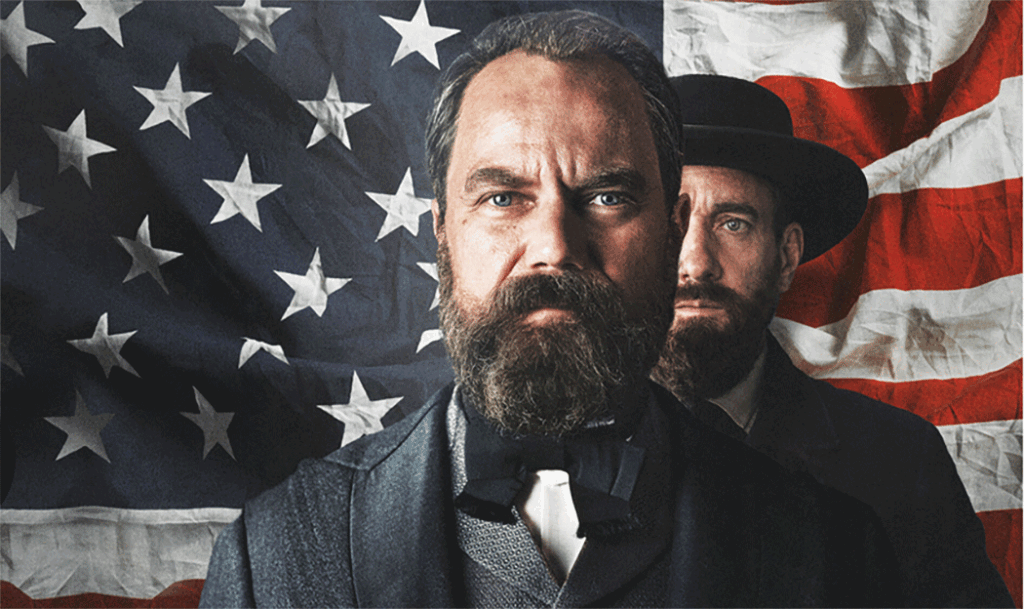
Death by Lightning introduces James Abram Garfield, an American leader we might not recall, who served too briefly as our 20th president. Based on our nation’s history and Candice Millard’s 2011 book, Destiny of the Republic, the four-part Netflix miniseries showcases Garfield’s personal and Congressional life, and the 1880 Republican convention that propelled him into the nation’s highest office. Though Garfield wasn’t even running for president, he displaced Grant’s third-term run when the Republican party nominated him as a third-choice compromise candidate to appease the party’s opposing factions. Garfield won the presidency, but an assassin’s bullet ended his term after four months, and just 16 years after President Lincoln’s assassination.
Death by Lightning features Michael Shannon as President Garfield. And the more we get to know him, the more we appreciate Garfield’s genuine nature and humility. Born in Ohio to an impoverished family, Garfield was literally the last president born in a log cabin. But his education all the way through college made him both a scholar and a teacher. After studying law, he was elected to Congress and later became president. Among elected officials, Garfield was unique, given his gentle manner, wisdom, sense of humanity, and his support of equality. Whatever office he held, he considered it a public service rather than a seat of power. Some historians believe he could have become one of the best presidents in U.S. history.
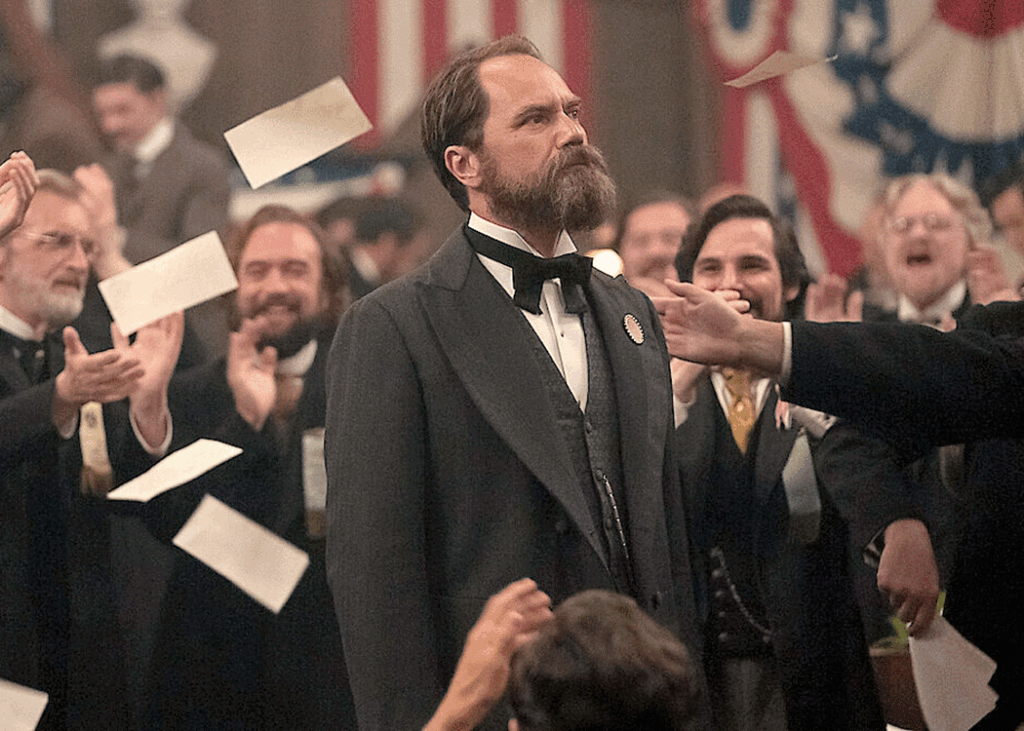
“Death by lightning” refers to Garfield’s refusal to obsess about his safety, insisting that “assassination can no more be guarded against than death by lightning, and it is best not to worry about either.” And now we introduce history’s other main character, Charles Guiteau, portrayed with a requisite sleazy touch by Matthew Macfadyen. Guiteau was a failed lawyer, an annoying misfit, and a mentally unstable man who lied, stole, and cheated. He tried joining the free love community in Oneida, New York, but the women avoided him. After departing, he unsuccessfully sued the commune for ruining his life. Guiteau, we’ll learn, is beyond crazy. He’s dangerous.
President Garfield schedules time for each citizen requesting a private meeting, whether it’s to ask questions, pose suggestions, offer praise, or complain. This was part of the job description of Commander in Chief. Even during the Civil War, President Lincoln met with citizens in encampments near the battle grounds, sometimes pausing his strategy meetings with General Grant. (Today we can write to the president and receive a wordy acknowledgment written by interns.) Garfield once met with Guiteau but fled the meeting without explanation when he learned his wife was ill. The truth is the better story, and the writers should have used it. Guiteau asked to be appointed to a diplomatic position, which Garfield refused. Guiteau sought vengeance with the aid of a gun.
Across the board, this production scores well: well directed by Matt Ross, well written by Mike Makowsky, and well performed by a solid cast that includes Nick Offerman, Bradley Whitford, and Shea Whigham. Betty Gilpin plays First Lady Lucretia Garfield, who warrants a footnote. Lucretia organized Garfield’s presidential documents after his death, a task that established the first presidential library. And Alexander Graham Bell invented the metal detector to secure the White House entrance. It was a worthy precaution, although historically, assassins favor public spaces: Garfield was shot outside the train station, Lincoln was in the Ford Theater, and JFK was riding in a convertible in Dallas.
Death by Lightning is not necessarily an inspiring romp through democracy. Members of Congress seem as confrontational and self-absorbed in 1880 as they are today. Representatives are people, and people are imperfect. And when voted into office, people are mesmerized by power. The irony continues. America escaped the rule of British royalty only to recreate the same structure at home. Our leadership became the new form of nobility that often forgets to serve the masses.
Through 250 years, our nation’s capital “keeps on keepin’ on.” Names and issues vary, but the public-servant concept never catches on. Though we would all rest easier if we were certain that no administration would ever favor “an efficient electoral system” that relieved its citizens of the burden of voting.
Garfield was the post-Civil War president we never knew but who seemed like the rare politician the public could trust. His assassination, and those of so many other politicians, including President John F. Kennedy, Senator Robert Kennedy, President William McKinley, and political activist Charlie Kirk, defy American principles with a loud, violent message of intolerance against an opposing a point of view. Sadly, there are long lists of political victims online, and these acts tarnish our country. We’re the United States of America. United States. United. We can do so much better.