
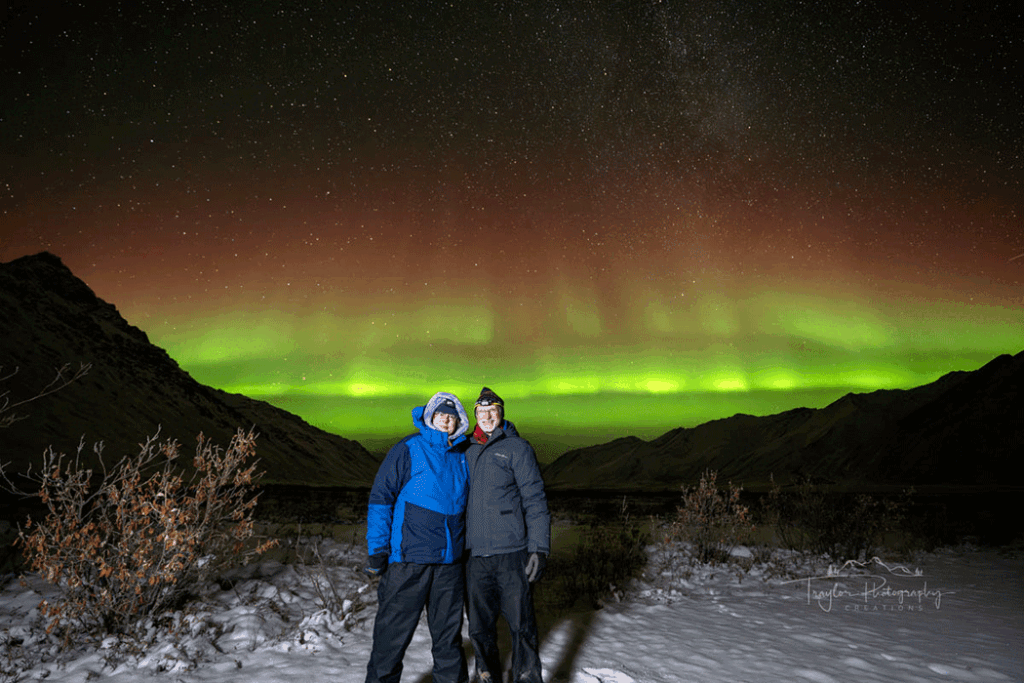
I went to college at Penn State with a group of guys from Philadelphia, all survivors of an inner-city high school. My lust for adventure started early, and Penn State was my first big adventure. Not long after arriving, one of our group had the chance to go on a research project to the Brooks Range in far northern Alaska. David joined a crew that flew into the Gates of the Arctic National Park in the summer of 1970. It was bold and exciting, and from the first time I heard about it, I wanted to go. My opportunity didn’t arrive until 54 years later.
Like many others, my wife Joan and I are devoting part of our golden years to seeing the world. When it came to deciding what place to go next, Joan said that if she never went on another trip, she would regret not having seen Alaska.
So we went to Alaska!
For many, going to Alaska means getting on a cruise ship in Seattle or Vancouver and sailing up through the Inside Passage. But I thought if I’m actually going to Alaska, I don’t want to see it from a cruise ship—I want to travel to the interior. So I researched various options and found a guide who leads three-day photography tours into the Brooks Range. Done. Booked. Fifty-four years later, I was finally going to see what David saw.
Northward Bound
The Brooks Range is the northernmost mountain range in the Western Hemisphere. And to see it, you really have to want to get there.
We took a six-hour direct flight from Chicago to Anchorage. After landing, I kept thinking I was in another country. Alaska is as American as anywhere in the U.S., but I had to keep reminding myself that I was still in the States.
We spent the night at the historic Lakefront Anchorage Hotel, where presidents have slept and international leaders have convened. The next morning, we hopped into our guide’s van for the eight-hour drive to Fairbanks, where we stayed at yet another historic inn, Pike’s Waterfront Lodge. We were only halfway to the Brooks Range!
Much has been written about the size of Alaska, but nothing replaces the experience. From the tip of the Aleutian Islands to Hyder on the border with Canada, Alaska is almost as wide as the lower 48 states. Alaska is 20 percent of the United States and has more coastline than the whole rest of the country.
The Dalton Highway
From Fairbanks, we drove another eight hours north to our home for the next few nights, Wiseman, Alaska. About two hours into our journey, we reached the Dalton Highway. This is the only road to the northern interior of Alaska. When my friend David traveled here in 1970, the Dalton Highway had not yet been built. His only way north was by small plane.
The Dalton Highway was originally built by oil companies to support the Trans-Alaska Pipeline. When construction was completed in 1972, the highway was turned over to the state. It remains a dirt road over most of its length.
This is not a place for casual travelers. Most rental companies do not allow their vehicles on the Dalton Highway. The Alaska Department of Transportation advises having two spare tires, extra food, water, blankets, a propane heater, and extra cans of gasoline before heading north. Once you’re on the highway, there’s only one gas station. It’s at Coldfoot, about 200 miles north of Fairbanks.
Wiseman, Population 12
I was glad that we had booked an experienced and well-equipped guide, Carl Johnson, of Alaska Phototreks out of Anchorage. When we arrived at Wiseman, population 12, Carl took us to a tiny inn: four rooms connected by an outdoor porch, a shared kitchen, and bathroom. If you needed to use the bathroom in the middle of the night, you had to don your parka and shoes.
On our first morning we were given a tour of Wiseman, an old gold-mining town, by resident Don Miller. Don is what some people call a citizen scientist. It would be difficult to find anyone who knows more about northern Alaska than he does.
There are no services in Wiseman. Don has solar panels and a very large bank of batteries. During the long summer days he charges his batteries to capacity, then slowly draws on them through the long, dark winter. Most years that all works as designed.
Wiseman was once a thriving hamlet of gold panners who took advantage of the stream that runs along the side of the town, but today our tiny tour group—five people, including guides and tour participants—swelled Wiseman by nearly 50 percent.
Don is a second-generation resident. His parents built a chapel onto the back of his house with ample chairs for the tiny population. And although they can only accommodate small groups, they do have a gift shop containing small art pieces by local artists.
Chasing Auroras
In the afternoon, we napped and had a brief class on how to hunt auroras. Then we headed north. Wiseman is 62 miles north of the Arctic Circle. We drove to Galbraith Lake at the northern end of the Brooks Range, where Carl cooked dinner on an open grill he’d brought in the back of the van.
It was late September and everything was covered with snow, but Galbraith Lake was not yet frozen. As the sun declined towards the horizon and the air chilled, steam rose from Galbraith Lake, creating a shroud of white fog over the water and its immediate surroundings.
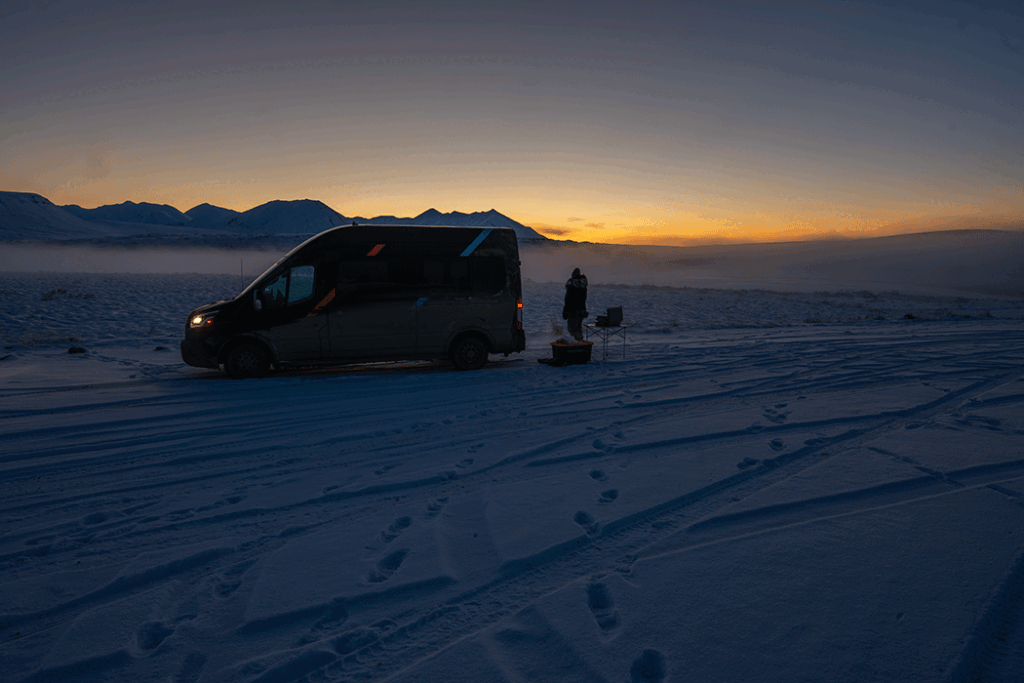
While Carl grilled, we roamed the Galbraith Lake area. I photographed everything. I kept shooting as the sun set and we headed into blue hour. The blue hour wasn’t yet over when the auroras struck—from horizon to horizon across the sky. It’s one of the most exciting natural phenomena I have ever seen.
From blue hour into full dark, the auroras intensified. Then they started moving south, and we jumped into our van and followed them. All night we would shoot for a while, then pack up our tripods, hop in the van, and drive further south. It got colder and colder. The lowest temperature I saw that night was 5 degrees Fahrenheit.
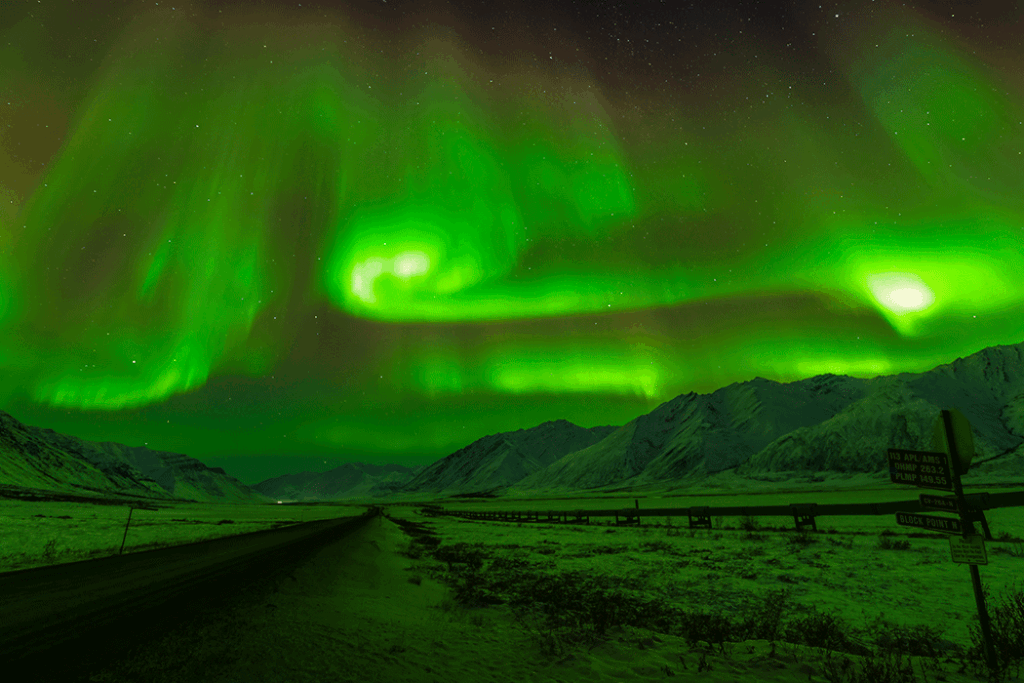
The auroras! They felt like the light of God descending on me. That’s the only way I can describe them. The energy! The sight! The mostly green auroras turned the snowy landscape green. They moved in swirls, streams, curtains, waves—they danced. They took our breath away.
Sometime around 5 a.m., with one of our tour participants already asleep in the van, we headed back to Wiseman, exhausted but filled with visions of dancing lights in the sky.
The next day, after waking around lunchtime and napping before sunset, we headed out for a second night.
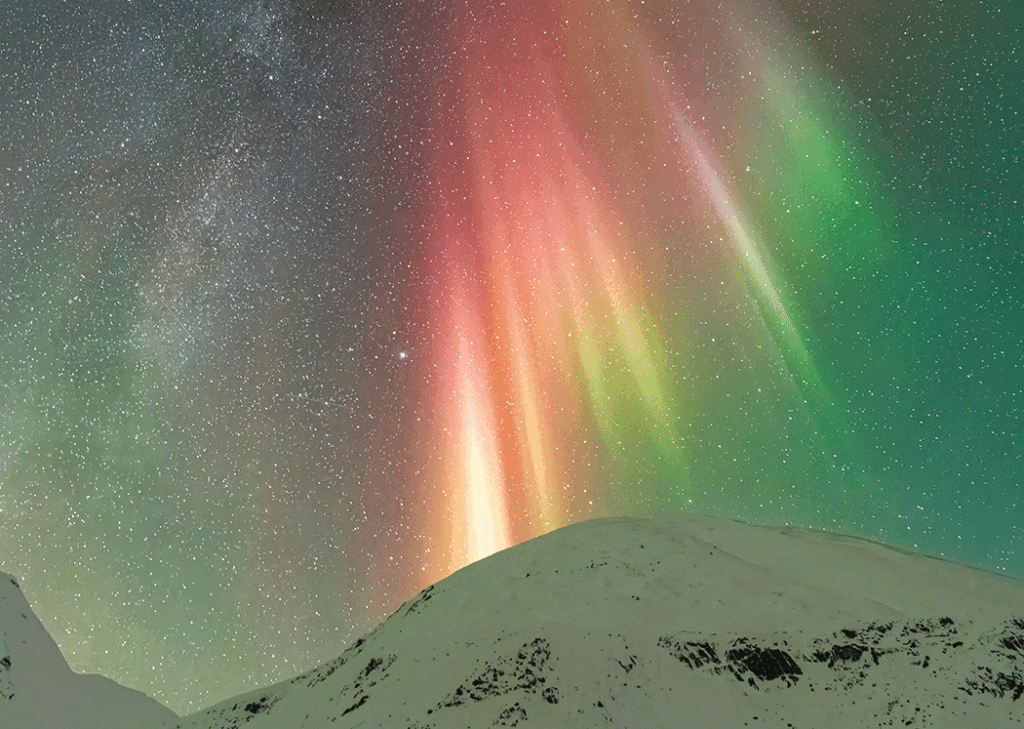
This time we drove to the banks of the Dietrich River, where there’s a boat launch just off the Dalton Highway. On the rocky flats next to the river, in view of the awesome Mount Sukakpak, we lit a campfire to give us a warm base in the cold night. And then off we went to walk around and find places to photograph the fabulous show above us, shooting the reds, greens, yellows, and whites as they streamed across the sky until we couldn’t keep our eyes open.
Even with the lights in the sky, it was so dark we couldn’t see each other from just a few feet away. Human settlements are so few and far between that there is zero light pollution. At Galbraith Lake, the night before, we were in the North Slope Borough of Alaska—a single county that’s as large as the state of Oregon but has fewer residents than Jefferson County, Iowa.
Despite the late night, satiated by one of the greatest experiences in the world, we awoke early the next day to begin the long two-day drive back to Anchorage.
Our guide Carl is a retired lawyer who has made his passions for photography and Alaska into a late-life business. As a previous Artist in Residence at the Gates of the Arctic National Park, Carl was a wealth of information about the state, its government, its history, and its abundant landscape and wildlife. Alaska’s nickname is “the last frontier.” I don’t know if it’s the last, but anyplace outside of its cities is definitely frontier living.
Don Miller is a true frontiersman, probably the only one I have ever met.
There are wonderful places to go in the world today, but so many of them are overrun with tourists. In a single year more people visit Iceland—a truly spectacular place—than have ever been to Wiseman, Alaska, in the entire history of mankind.
The Alaskan Brooks Range is as wild as it gets. I could see the Milky Way with my naked eyes. I was able to get photos that I doubt I could get in most of the rest of the world. And because the Dalton Highway goes right through these mountains, I didn’t have to load up a backpack full of gear and hike for miles to see it. Properly outfitted and with the help of a local guide, I was able to see it all just from the side of the road.
Just to be there in that place was one of my life’s great adventures. And to capture photos that can’t be taken anyplace else in the world was both a thrill and a privilege.
Hal Masover is a freelance writer and photographer. You can see his work at EarthSkyandYou.com.