
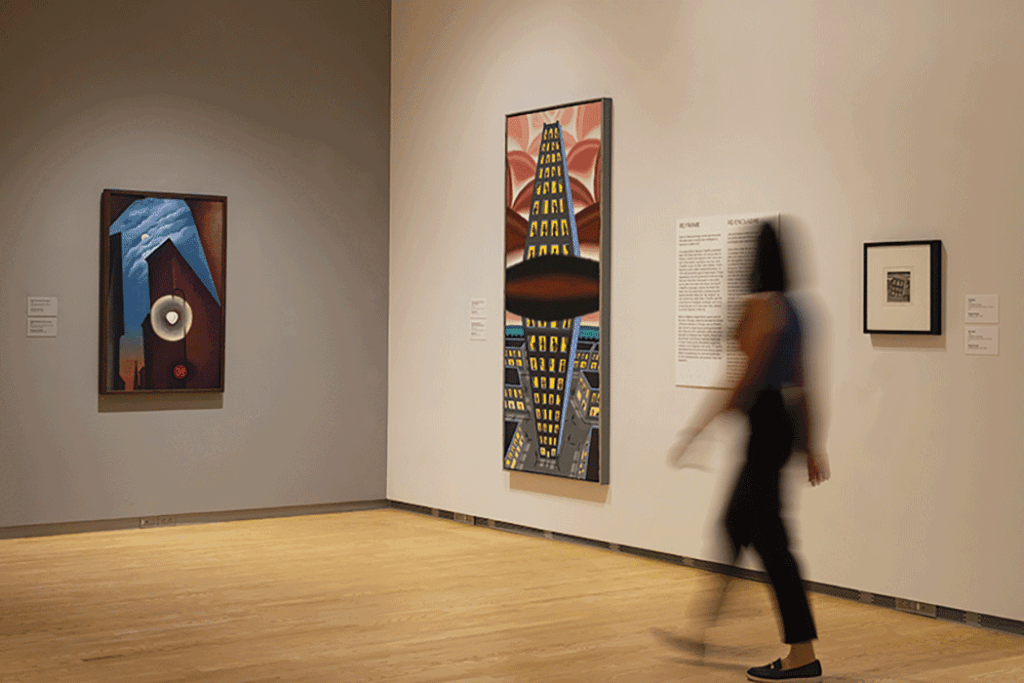
An acclaimed urban landscape by iconic American artist Georgia O’Keeffe (1887–1986) is on view through January 25 at Iowa City’s Stanley Museum of Art, part of an international exchange with Spain’s Museo Nacional Thyssen-Bornemisza. Titled New York Street with Moon (1925), the painting illustrates O’Keeffe’s perception of the urban experience. As she expressed it, “One can’t paint New York as it is, but rather as it is felt.”
The first in a series of cityscapes O’Keefe called her “New Yorks,” New York Street with Moon is on display as part of a reciprocal loan arrangement. Two years ago, the Thyssen-Bornemisza asked to borrow Jackson Pollock’s Portrait of H.M. (1945) for their exhibition Warhol, Pollock and Other American Spaces, currently on display through January 26. In exchange, Visiting Senior Curator Diana Tuite requested the O’Keeffe painting.
“It was serendipitous,” she says. “We felt really strongly that this was an artist who was familiar to many people in our communities, but not someone whose work we were fortunate to have in the collection.”
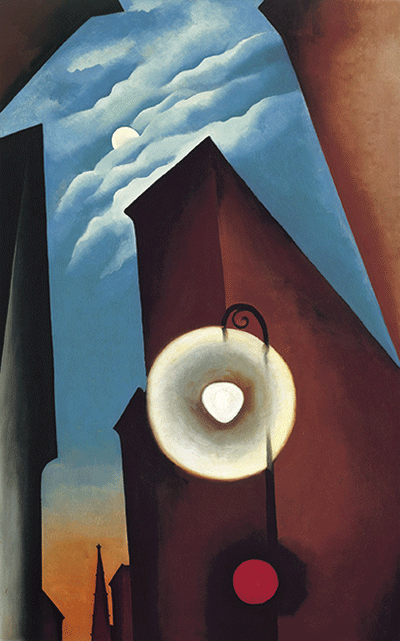
New York Street with Moon not only resonates with viewers as a work by a well-known artist, it also exposes people to O’Keeffe’s less familiar cityscape work. “With this remarkable loan,” Tuite says, “we can show how invested she was in representing modernity and urbanity—bound up as these topics are with national identity—and how the city in turn sharpened the vision she applied to the rural landscapes for which she is best known.”
Tuite notes that this early painting reflects O’Keeffe’s development of her signature style and also rehearses things she developed in her later work, such as using perspective “to radically disorient through composition.” In New York Street with Moon, Tuite feels “O’Keeffe captures the changing nature of the early 20th-century city, where skyscrapers are relatively new engineering marvels—symbolic of American progress.”
O’Keeffe’s painting is installed alongside American artist Roger Brown’s View From Halfway Up (In Fish-Eye Photo-realism) (1978), courtesy of University of Iowa alumni Christine and William John Robb III. Brown, an artist with strong connections to Chicago, studied at the School of the Art Institute of Chicago, where O’Keeffe had studied and had her first retrospective—making it one of the most pivotal institutions in establishing her reputation.
Brown’s painting depicts an urban landscape about 50 years after O’Keeffe’s. Tuite explains Brown’s painting “shows another perspective on the city as this phenomenon of the 20th century. . . . His style is incredibly different and very much indebted to popular visual culture, but also to Georgia O’Keeffe, who was very instructive for Roger Brown. He studied her work at the Art Institute of Chicago.”
Tuite feels the paintings make a wonderful pair. “It’s a fun thing to have an exhibition in miniature, with just a few works of art.” This mini-exhibition also helps introduce a new series the Stanley has begun, called Re/frame, which invites viewers to look at works in a new light, examining how contemporary and historic works speak to each other. Seen together, O’Keeffe’s and Brown’s different interpretations of urban landscapes create a dialogue on how images of the built environment can both express and critique ideas about American progress.
“There are great moments of visual rhyming between the paintings, too, in the ways that both artists use deformation as a strategy,” Tuite adds. She says O’Keeffe depicted the Hotel Chatham from the street below at an exaggerated angle, then used the position of various light sources—a stoplight, a street light, and the moon—to create a visual rhythm, leading the viewer’s eye across the composition, ultimately to the sky.
In comparison, she says, Brown used a very graphic style and a heightened sense of exaggeration. His skyscraper resembles a spaceship, while silhouettes symbolize the many people who occupy the city, yet are set apart within it, capturing the sense of alienation felt in a later 20th-century metropolis.
Tuite feels the mini-exhibition is perfectly suited to the contemplation encouraged by the winter season. “We are all deeply invested in questions of place, community, and the fabric of our society. I think that the paintings, while marking a very different moment in the O’Keeffe instance, a century ago, bring to the surface questions about where we live, how we see ourselves, and how we relate to other people. These are great paintings for prompting some of that reflection on ourselves, our communities, our relationships, and the places that we inhabit.”
She also feels this mini-exhibition presents a major opportunity for students and aspiring artists to see an early work by O’Keeffe, who went on to have amazing longevity and international fame. Brown, whose life was tragically cut short by AIDS, is a less familiar artist, but was obviously inspired by comic books and cartoons, making his work feel inherently familiar and full of wonder. Together, these paintings create a fascinating dialogue on the various symbolisms found within depictions of our built environments.
“We are enormously grateful to the Carmen Thyssen Collection and the Thyssen-Bornemisza for sharing this incredible painting with the people of Iowa,” says Stanley Museum Director Lauren Lessing.
This mini-exhibition happens to coincide with the painting’s hundred-year anniversary, so make the trip to the Stanley to celebrate the centennial anniversary of this incredible work of art.
For more information, visit StanleyMuseum. uiowa.edu.