
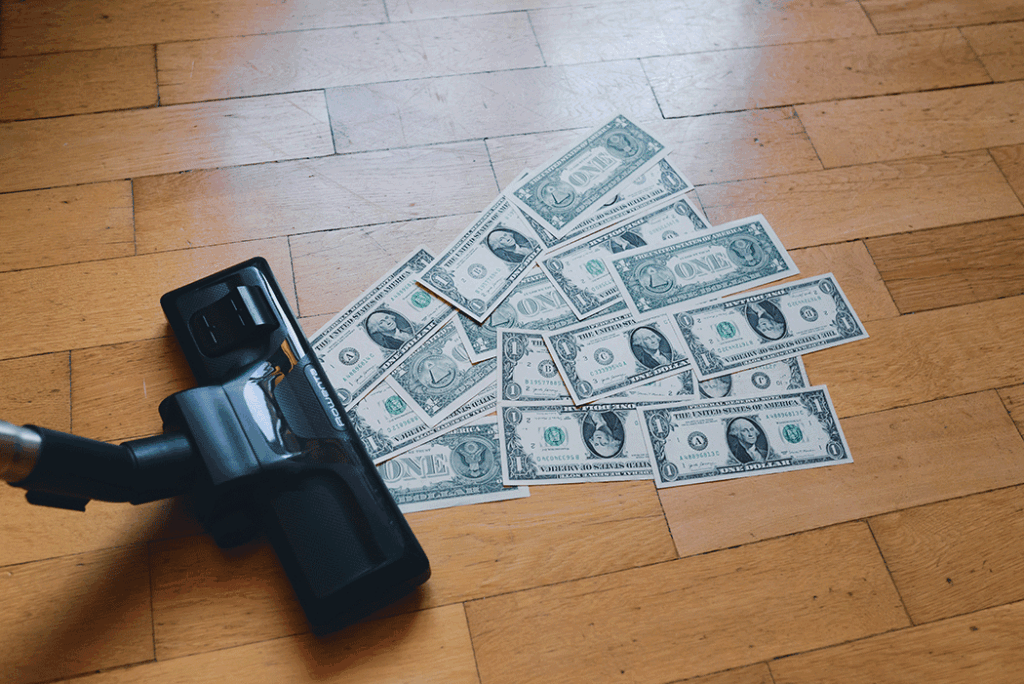
Remember the Nigerian prince scam? It was so bad it makes me laugh just thinking about it. I don’t remember all the details, but it involved a poorly written, broken-English email from a stranger claiming to be an actual Nigerian prince who was unable to access millions of U.S. dollars that were rightfully his, and you, a total stranger, could help him by setting up a U.S. bank account into which you would deposit money. With that done, this prince would be able to access his money and would pay you a handsome reward.
We haven’t seen emails from the Nigerian prince for a long time. Instead, we are seeing ever more sophisticated scams.
For a few years, I saw the same scam targeting photographers in various different ways. Many of you know I am a freelance photographer, and what you may not know is that it’s a tough business—you’re always looking for your next booking. So emails asking about your availability to photograph an event get attention. And photographers’ emails are easy to obtain because they put their contact info out in public as part of their efforts to get business.
I don’t know how many photographers fell for this scam. At first, I thought these emails were legitimate. The person reaches out asking you to photograph an event, usually a wedding, birthday, or anniversary party. After you agree to photograph their event, they send you a deposit. Let’s say, for example, that you agree to photograph their wedding for $3,000 and the deposit is $300. But when the deposit check arrives, it’s actually for $2,000. The scamster immediately apologizes. Apparently, their boss is paying for the wedding and accidentally sent you the money for the caterer’s deposit, too. Would you mind sending the caterer their $1,700 right away? They want to make sure the caterer doesn’t cancel on them.
If you send the $1,700 off, they’ve got you. The $2,000 check they sent you will bounce for insufficient funds, but you won’t know that for a couple days. Meanwhile, the $1,700 you sent to the scamster or one of his team will have been cashed and the $1,700 disappeared.
Pretty slick. Scamsters tricked a lot of people with this until they ran into too much suspicion. They’ve tried various versions of this particular scam, and I’m sure they’ll try more.
For example, recently I was contacted by someone offering to pay me $5,000 to do a fashion shoot and to hire models and makeup artists. They sent me the look they wanted and said they would send the clothes. It sounded like a great opportunity for a hungry photographer. But it was the same scam in a different guise.
Once again, the trick was to get the victim to deposit a bad check and forward some of the money to someone else. But this time, the English was flawless and the scamsters knew just enough about the photography industry to speak the jargon. And, no, I didn’t fall for it, but I am well aware that these scams are going to keep getting more difficult to recognize.
Not long ago, I saw a post on Facebook by a friend of mine. Her father-in-law was going into assisted living and they were selling a bunch of his stuff. One of the items was a golf cart at half the price it was worth, so I reached out. She asked me if I could send her the money via Zelle and, since she is a friend, I started the process. This is the closest I’ve gotten to being scammed. Zelle red-flagged the transaction, and when I messaged my friend about it, she started pressuring me to call Zelle and tell them it’s okay. Red flags on top of red flags. Eventually, I spoke with my friend on the phone and found out that her Facebook account had been hacked, and this garage sale was a scam.
With all the information about each of us being available and the rapid advances of AI, I expect scams will get harder and harder to detect.
Almost getting caught by one heightened my alertness, but possibly within the next five years, the voice on the phone that sounds like your friend may actually be a scamster. We’re not there yet, but the time may be close.
For now, keep two things in mind. One, if it sounds too good to be true, it probably is. Remembering this will save you from a world of pain. And two, texts and emails are all vulnerable. You may or may not be communicating with the person that you think you are. Before sending any money anywhere, actually talk with the individual, preferably in person.
And be skeptical.