
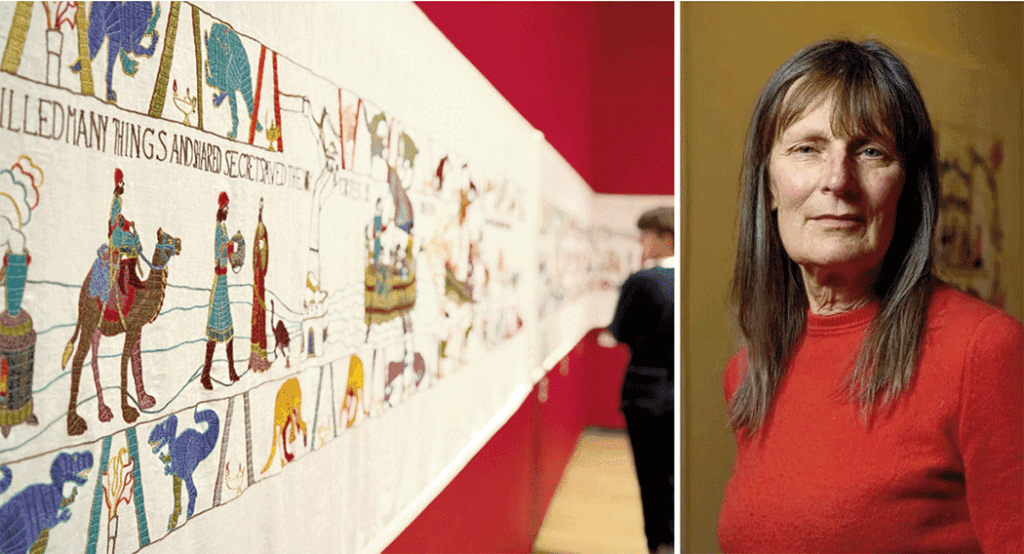
Canadian artist, filmmaker, and environmentalist Sandra M. Sawatzky will share details about the nine-year undertaking to create the 220-foot embroidered tapestry on Thursday, April 16, 6-8 p.m., joined by UI faculty members and moderated by curator Diana Tuite.
The Black Gold Tapestry, Canadian artist Sandra M. Sawatzky’s spectacular textile installation, runs through June at the Stanley Museum of Art in Iowa City. The product of exhaustive cross-disciplinary research, and created over the span of nine years, Sawatzky’s 220-foot-long hand-embroidered artwork is filled with intricate and stunning imagery. Created with silk and wool threads on flax linen cloth, the tapestry documents the saga of oil—from the age of dinosaurs through ancient cultures and up to the industrial and information ages—tracking global societal change and energy transition. The phrase “black gold,” which has been used since the early 20th century as a name for oil, evokes how precious and valuable oil became.
Sawatzky, who worked in the film and fashion industries as well as arts education, resides in Calgary, the oil capital of Canada. After two decades of working in film, Sawatzky was inspired to start embroidering after she went to an exhibition of women’s embroidery with her daughter. Given Sawatzky’s history of making clothes and her background in fashion, she picked up basic embroidery stitches fairly quickly and wanted to create a narrative figurative work.
“As a filmmaker, I liked telling stories,” she says. “I thought about the Bayeux Tapestry, which is almost 1,000 years old, hand embroidered, and tells a history of the Battle of Hastings—the repercussions of which are still felt today. I thought it would be interesting to do some sort of parallel.”
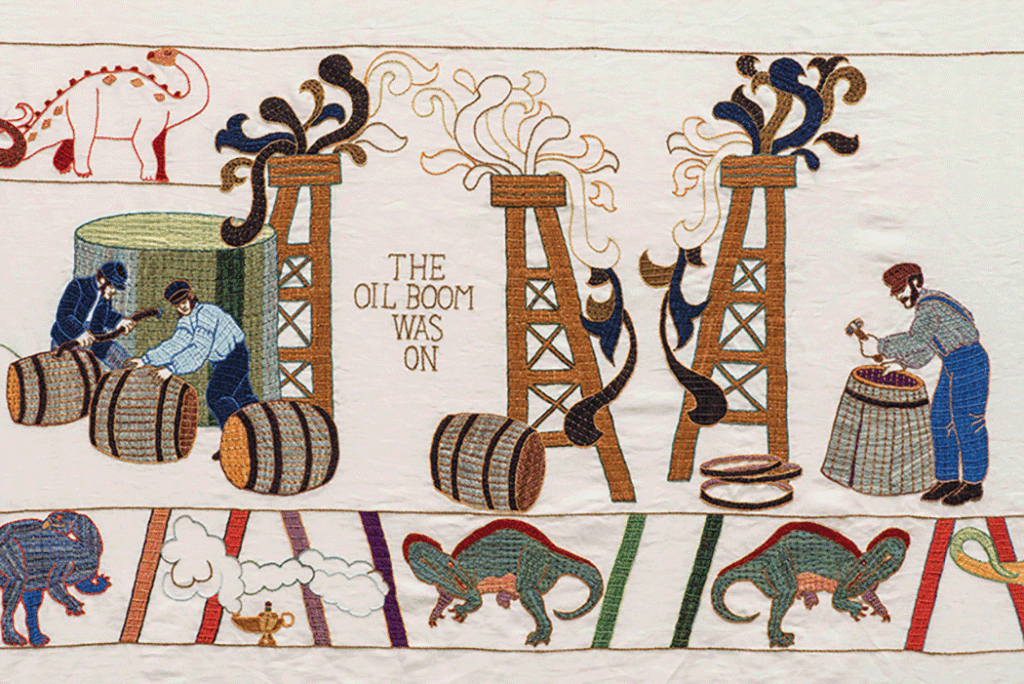
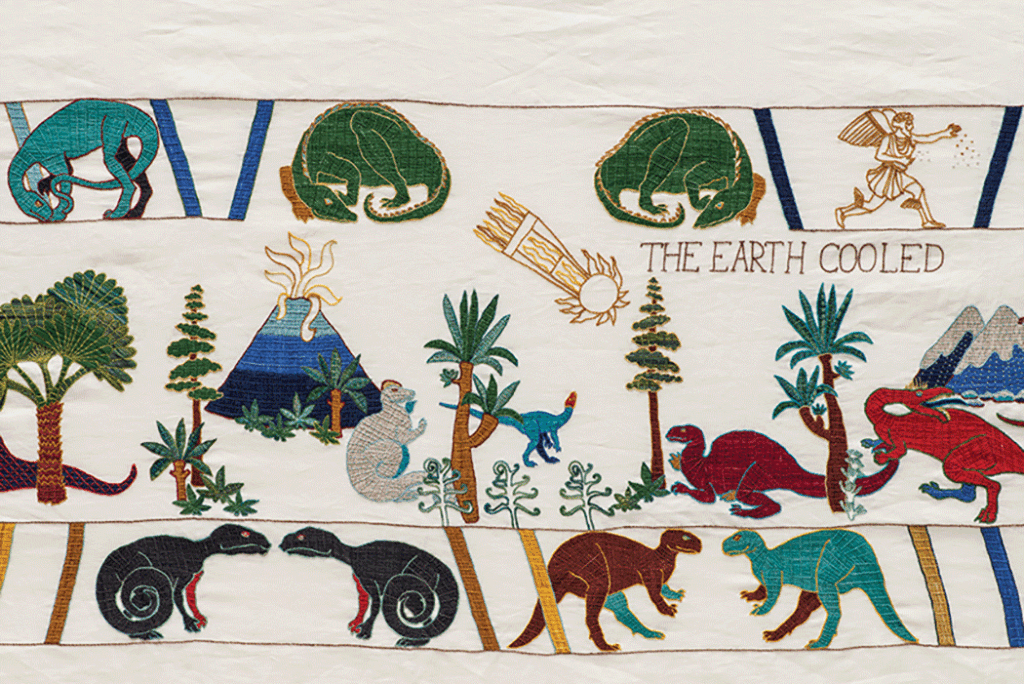
After reading about one of the early oil barons, she decided to focus on the history of oil, which began over 200 million years ago, during the age of dinosaurs, when oil formed in the earth. She researched how people used oil in ancient times, discovering it was initially used as glue and a water repellent. In second-century China, people began distilling it. And by the 7th century CE, the Byzantium empire was using oil to make incendiary bombs called Greek fire. Over time, oil became a form of fuel.
In tackling such a massive project, Sawatzky says the skills she learned in filmmaking “really paid off, in terms of planning and figuring out the timelines.” She adds, “I knew how to sew. I knew how to plan a project. I knew how to put the time in—when I made my feature film, it took four years to make. And the tapestry was nine years in the making.”
She has found that returning to hand work has been very rewarding, and she hopes her embroidery inspires others to explore working with their hands. “When you learn how to do something with your hands, it gives you a certain sense of confidence. Whether it’s a sewing project or a piece of furniture, or any of those things that require craft and putting things together, making things on your own builds confidence and skills, and is also really good for the brain.” She feels that choosing to make things by hand in this age of extreme electronic technology is revolutionary.
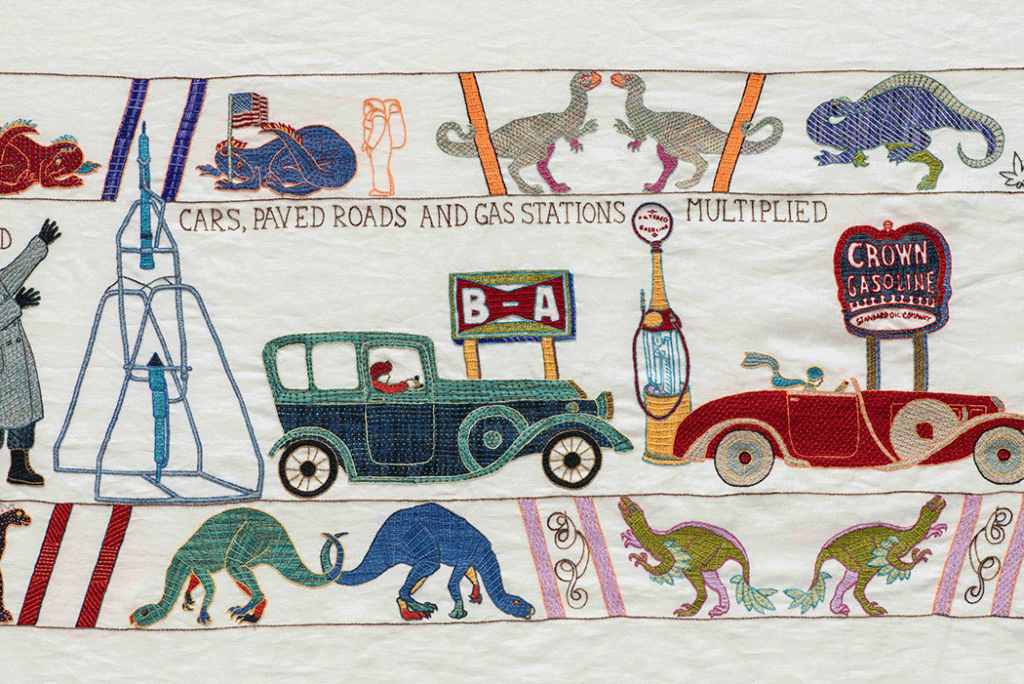
Sawatzky remained faithful to her source of inspiration, using the stitches and style of the 11-century Bayeux Tapestry, which depicts people in outline against a pale background. In order to portray the flavor of the various historical eras depicted in The Black Gold Tapestry, Sawatzky mimicked each era’s art style, using her background in design and illustration. She wanted her tapestry “to have a Celtic element to it, that reflected the original tapestry—the mother of all tapestries,” while each historical panel illustration mirrors the artwork of that era, “reflecting the stylized approaches to the way in which figures were presented in art of that time.”
The Black Gold Tapestry is organized into three painstakingly embroidered pictorial bands full of fascinatingly detailed imagery, with the top and bottom borders comprising over 400 dinosaurs. Sawatzky describes The Black Gold Tapestry as a “film on cloth,” and calls it “an antidote to AI and tech overlords.” She explains, “In a future worldwide power shortage, the tapestry will abide and keep on trucking, since it’s plugged in without needing to be plugged in.”
Sawatzky debuted her monumental textile in 2017 at the Glenbow Museum in Alberta. Since then, it has done a lot of traveling, being featured in a number of acclaimed exhibitions at other major museums and galleries. The Black Gold Tapestry may be viewed at the Stanley through May 31st.
Diana Tuite, the Stanley’s Visiting Senior Curator of Modern and Contemporary Art, first encountered The Black Gold Tapestry at the MassArt Art Museum in Boston in late 2024. “I was overwhelmed by the knowledge, ambition, and labor that it materialized,” she says. “It was magical to see people in awe of this massive undertaking, when we so often associate immersion and spectacle with technologies like augmented reality. Embroidery is an ancient form of expression. It’s a technique everyone can intuitively understand, but we rarely see it applied to a narrative that we can see ourselves in.”
Tuite feels the tapestry is an excellent fit for the Stanley for a number of reasons. “The global history of fossil fuel extraction is a story of interest and relevance for each of us, and Sandra’s pictorialization of the subject offers points of entry for audiences of all ages. It prompted me to learn that Iowa is among the top ten U.S. states in total energy consumption per capita—and the only one that does not produce crude oil.”
Furthermore, Tuite notes that Iowa has rich craft traditions. “Many of us have rediscovered the joys of handiwork, particularly since the pandemic. It’s a medium that was relegated to women for centuries and one that makers have also used to trouble that history and sow resistance.” Tuite says the U of I’s Cross-Stitch and Embroidery Club has been invited to be part of future programming for the show. The exhibition includes touch labels designed by Iowa fiber artists Linzee Kull McCray and Codi Josephson, which illustrate the four stitches used by Sawatzky, “providing visitors with an opportunity to physically appreciate the materials, labor, and techniques involved in the fabrication of this immense work of art.”
Tuite also emphasizes the quantity of sheer labor that Sawatzky put into this artwork. “She stitched nine hours a day for years to create The Black Gold Tapestry,” Tuite says. “The experience of viewing it is similarly slowed down. We must move along the expanse of the piece in the gallery, tracking its narrative march through time and considering the relationship between this forward motion and civilizational progress. It is like a film that we can advance at our own pace.”
Tuite feels that by using the Bayeux Tapestry as a template, “Sandra implicitly draws comparisons between a military conquest and the extraction of the natural resource on which the modern military industrial complex depends.”
She thinks it will be “especially instructive for students to see how Sandra synthesizes scholarship in many different fields and translates it into a creative vision.” She adds that the tapestry “also offers an extraordinary example of someone’s second act in life, so to speak.”
For more information, see StanleyMuseumofArt.com.