
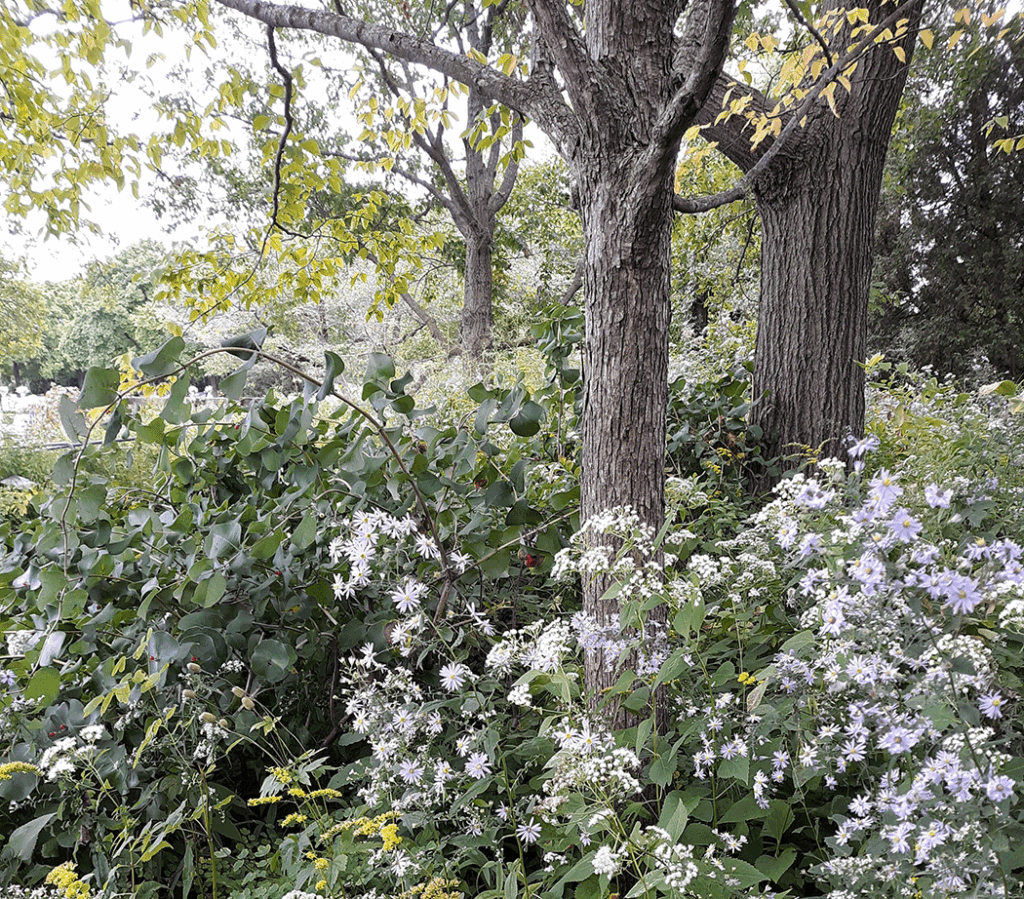
If a landscape has a sense of completeness or unity, people recognize it as beautiful. A sense of unity is created by a harmonious blending of plants that naturally grow in a given habitat. This natural selection limits the number of species, thereby creating a simpler, unifying theme. For instance, the rolling plains of Iowa commonly have just four plant ingredients in the landscape. There are 1) canopy trees predominately of oaks, 2) tall shrubs or smaller trees along the woodland or savanna edge, 3) grasses creating a matrix of open prairies, dotted with 4) wildflowers such as sunflowers, coneflowers, goldenrods, and asters.
Limiting the tree canopy selection to regional keystone species such as oak, hickory, and wild black cherry provides the signature look of Iowa. Oaks are necessary for the ecosystem in Iowa because the deep tap roots can easily withstand our droughts and allow other plants to share the ground around the base of the tree. The strength of the oak’s wood withstands our strong storms and windy days. The canopy of oaks is somewhat open and provides dappled sunlight for perennials that grow underneath. Over 250 caterpillars feed on oak leaves, which birds use for feeding their young. Not every site has room for an oak, but if possible, start the landscape design with an oak!
Pin oak, shingle oak, and white oak have an added advantage of retaining russet-colored leaves in winter that make a nice complement to the dark, evergreen foliage of eastern red cedar or white pine. This color play is due to red and green being opposite on the color wheel. Placing them next to each other creates a vibrant, high-contrast effect. The “ever-brown” foliage of these three oaks also provides winter cover for birds and a windbreak.
Regional native shrubs or small trees that are typically found at the forest edge or along fencerows are wild plum, chokecherry, redbud, Iowa crabapple, American hazelnut, gray dogwood, and fragrant sumac. In spring, the wild plum, chokecherry, and gray dogwood have white flowers. The spring redbud flowers are a bright pink, and our native Iowa crabapple also has pink flowers.
Prairie grasses also provide the signature look of Iowa. While there are many species of grasses in the prairies, the four most common are Indian grass, big bluestem, switchgrass, and little bluestem. The grasses provide a matrix or ground cover in which prairie wildflowers are highlighted due to the less conspicuous grass backdrop. Think of them as filler plants for the background.
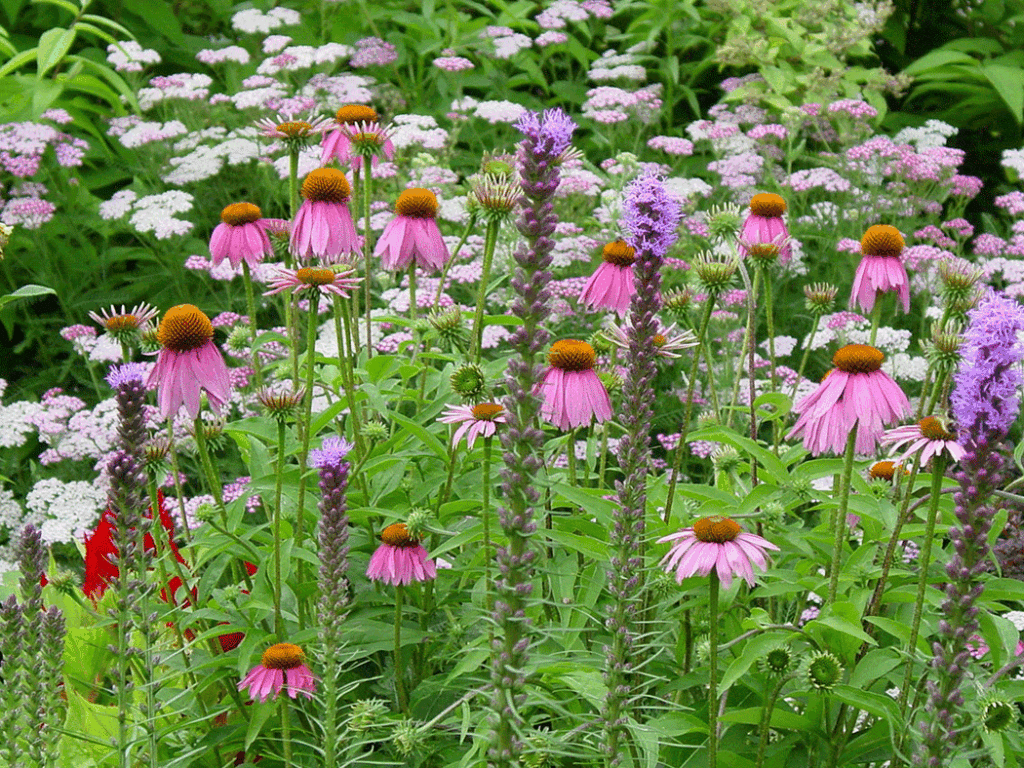
Of all the wildflowers, the aster family has the greatest number of species native to Iowa. This includes many types of goldenrods (solidago), blazing star (liatris), coneflowers (echinacea, rudbeckia), and symphyotrichum (the true asters).
Proportion and Scale
Smaller plants with natural geometric mounds are recommended for urban settings, especially by the entryway or in the front yard, so that they don’t overwhelm the architecture or aren’t perceived as messy. Examples of small native shrubs are coralberry, dwarf ninebark, Gro-Low sumac, sand cherry, and New Jersey tea. Lowgrowing ground covers such as prairie petunia, Missouri evening primrose, prairie violet, and prairie smoke are recommended for sunny areas. Buffalo grass and blue grama grass can be used as a lawn or a ground cover matrix in sunny areas. For shady areas, low-growing ground covers such as wild geranium, wild ginger, wild strawberry, woodland phlox, and common violets are recommended. Woodland sedges can be used as a lawn or a ground cover matrix in shady areas.
For large properties or in the backyard, the sky’s the limit—go big! Large shrubs can be used as a backdrop or to provide a screen or a sense of structure or framework. Examples are American hazelnut, wild plum, and nannyberry. In front of these shrubs, add tall prairie grasses and tall, dramatic flowering perennials.
Contrast and Focal Point
Use a plant with a striking structure or an object such as a birdbath or small pool, or a large container for a focal point that contrasts the soft appearance of the grasses and prairie wildflowers. Sawtooth sunflower, cup plant, or prairie dock are three plants that can be a focal point simply because of their great size and strong architectural look—they are the skyscrapers of the prairie perennials.
Contrasting textures also are easy to spot, such as the columns of blazing star or the wands of compass plant or the globular flowers of rattlesnake master. Nature will also add splashes of color with butterflies.
Repetition and Pattern
By repeating a particular grouping of plants, a pattern emerges that helps to create a sense of naturalness. Seeds of the mother plant are usually sown close by and create drifts of the same plant. Naturally spreading plants include sunflowers, goldenrod, several species of coneflowers, rosinweed, and wild bergamot. Naturally spreading shrubs that create thickets include American hazelnut, sumac, gray dogwood, and wild plum.
Balance
For formal gardens, symmetrical balance is favored, in which the same plants are used on both sides of a central walkway or doorway. For informal gardens, asymmetrical balance is used, in which a taller, vertical plant balances a long, horizontal one. This type of balance is more commonly found in natural settings and is used most often to create vignettes. A vignette is created by balancing contrasting plants with filler plants, such as the soft plumes of grasses that can be backlit in the early morning or late in the day so as to give a halo of mellow light that surrounds the plants in the foreground.
Steve Taylor will speak about native plants at the Fairfield Public Library on Saturday, March 21, at 10:15 a.m.
CAPTIONS
Oaks allow enough light for perennials to grow underneath their canopy.
Contrasting types of flowers, umbels of yarrow, wands of blazing star and daisies of purple coneflower.
Drifts of purple coneflower add a naturalness to a landscape design.
A vignette is created by the strong vertical tree trunks that are balanced by the soft woodland blue asters and elm-leaved goldenrods.