
The 2026 South by Southwest (SXSW) Conference & Festivals celebrated its fourth decade this year in a condensed format—over seven days in March rather than nine. In addition, the location changed from the Austin conference center to three separate clubhouses scattered across town. As a result, it was shorter, smaller, and less centered. Despite the many changes, however, SXSW still kicked butt!
The Music
SXSW originally began back in 1987 to publicize the Austin music scene. In 1994 it expanded to include Film and Interactive components, but music has always been the fest’s primary reason for existence. Alas, music has become the least important feature of SXSW. The music business—indeed, the world itself—has changed radically during the past 40 years. The number of artists performing as well as the number of attendees has significantly dropped. That said, more than 4,400 musicians from over 50 countries performed to enthusiastic audiences this year. There was still a ton of great music of all types to be heard.
Below is a list of the shows I enjoyed most. I refused to go to the big locations that featured well-known acts such as Alanis Morissette and Christina Aguilera, or the larger showcases with lesser-known acts such as Charley Crockett, Lola Young, and Ella Langley. These last three acts are marvelous artists, but I don’t like huge crowds and full-sized venues.
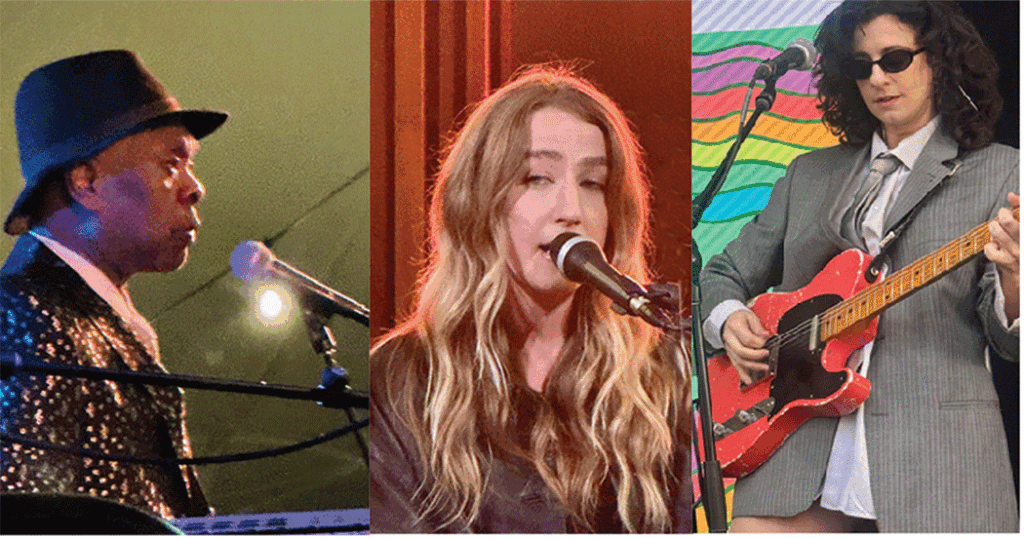
What has always made SXSW special is the intimate nature of the performances. Many of the shows are in small rooms at local bars and other places that hold at most a few hundred. However, I did attend the Luck Reunion, a multistage, all-day party at Willie Nelson’s ranch. (Luck Reunion is considered part of the broader SXSW experience, though it operates as an independent, exclusive event.) The five stages themselves vary in size—my favorite being the chapel, which holds 75 people. I enjoyed shows by folksinger Anna Tivel, country artist Dallas Burrow, singer-songwriter Willis Alan Ramsey, Ameripolitan artist Dale Watson, and roots rocker Kelly Willis. I also really liked rocker St. Vincent’s (Annie Clark) performance at the largest stage (World Headquarters) as well as 92-year-old Willie Nelson’s closing set on the same site.
Among other highlights were Angela Autumn’s rockin’ set and 81-year-old Booker T. Jones’s solo version of Marvin Gaye’s “What’s Going On.” When he got to the line “War is not the answer,” the crowd roared in approval.
While the Luck Reunion stands out as an all-day event from 10:00 a.m. until well after 11:00 p.m., the one thing it shared with my two other favorite shows was the long lineup of performers. I relished going to a club and staying for four or more acts of great music. The first night of SXSW featured a wonderful array of country and rock artists at the Sagebrush bar, including sensitive singer Tenille Townes, singer-songwriter Travis Bolt, self-called Amerijuana musician Tyler Halverson, Austin native Shakey Graves, and county rocker Aubrie Sellers.
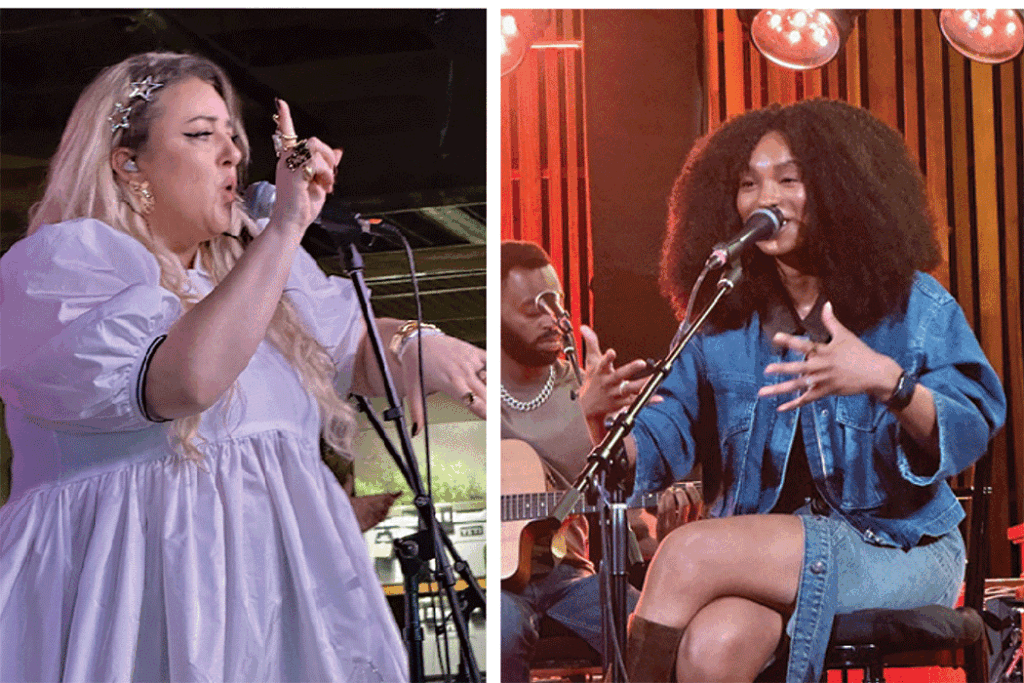
The Country Music Association has a program called Amber Health that provides wellness solutions to its members. This year it hosted a round robin of singer-songwriters who spoke about their mental health issues between songs. The young Georgia Webster sweetly opened the show with vulnerable yet humorous songs about growing up, dating, and such before red-dirt cowboy Wyatt Flores took the stage and showed everyone he was still shaking out of nervousness. Flores was followed by pop country’s Ingrid Andress, who confessed to the crowd that she was home schooled by religious parents and still recovering. Nashville’s Chase McDaniel shared his insights about feeling like he was a monster and outsider who needed help. Tiera Kennedy, unlike Andress, said it was her faith that kept her sane when she felt troubled.
SXSW celebrates all genres of music from across the world. International artists that deserve special mention include Brazilian singer Di Ferrero, Argentine songwriter guitarist Marilina Bertoldi, the French a cappella trio Les Itinérantes, Turkish-German singer Nilipek, Mexico City’s rhythmic R&B singer MITA, English pop star Tom A. Smith, and London’s MEEK.
Film and TV
The Film and TV section of SXSW brought out the stars, including directors Steven Spielberg, Boots Riley, and Judd Apatow; actors Demi Moore, Steve Carell, Larry David, Paul Rudd, Uma Thurman, and many more. These creative artists attracted big crowds to their movie showings, but their talks were almost impossible to attend because audiences lined up well before the celebrities’ scheduled appearances, and many who had waited in line for an hour were denied admittance.
I only attended one screening at SXSW, a documentary called Los Lobos: Native Sons about the 50-year history of the East Los Angeles band, which included interviews with Tom Waits, John Doe, and Linda Ronstadt as well as archival footage. The film was enjoyable even as the chronology sometimes got confusing. It culminated with a live acoustic performance by the band.
Innovation
The Innovation section (formerly called Interactive) was the largest and most attended section of SXSW proper, with sessions on a whole universe of topics ranging from space exploration, fusion energy, social media, and the future of education. By far the biggest topic was artificial intelligence (AI) and the host of issues that surround its emergence.
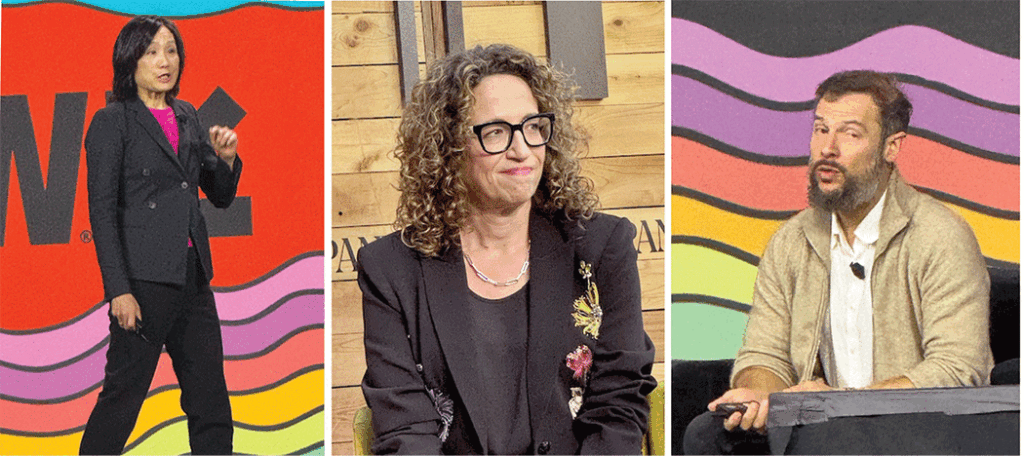
The most fascinating talk I attended was physicist Aza Raskin’s keynote lecture, “Nature Speaks. Can AI Help Us Listen?” Dr. Raskin pointed out that there are over 8 million species that share our planet, but that there has been little interspecies communication. Using AI’s ability to harness the complex interactions of speech, there are currently a host of projects eavesdropping to find out what the life forms are saying to each other and about the world in which we live. Did you know flowers respond to the sound of bees buzzing even though the plants have no ears, elephants name their progeny and that sticks with them their whole lives, and crows do most of their talking when in flight? The world is full of communication, but human beings hear almost nothing because we screen it out as noise.
The Hon. Michelle K. Lee boldly proclaimed, “AI is the most transformative technology of our generation” in her session on the “Real-World Impact of AI: Opportunities, Risks, and Intellectual Property Oh My!” She offered concrete examples of how AI is already impacting businesses and augmenting creativity, as well as the risks regarding intellectual property issues. She shared a seven-lesson playbook for AI implementation designed to increase productivity and drive revenue.
Futurist Amy Webb annually gives a report on emerging trends at SXSW. This year she gave a marching-band funeral service for emerging trends and said “convergences” of technology, society, and businesses are the best ways of tracking the future. “The future of work is human,” she said while noting machine-based labor will become increasingly important to ensure a workforce economy. She urged leaders to build around human advantage (judgment and empathy) rather than just machine efficiency.
SXSW has changed, but it still provides plenty of good music, a home for new movie and TV productions, and innovative thinking about technical advances. The fest continues to move ahead despite major disruptions in its format. May it continue to inform and entertain its audiences.