

Amish family farmer Allen Hershberger shifted to regenerative farming about five years ago. His farm in Bloomfield, Iowa, produces pastured eggs, A2/A2 certified sheep’s milk, butter, yogurt, chicken, and beef. “We are 100 percent chemical free,” he says. “We want to be beyond organic.” His goal is to raise high-quality food from the ground up. “Healthy soil makes a healthy animal. . . . In a nutshell, that’s how we operate our farm.”
The farm is a family endeavor, with Hershberger’s wife and their small sons all helping out. As the boys grow older, Hershberger says they will be taking on more chores. It’s important for him to create a family-friendly environment, and his love for the land and the animals he stewards is obvious. The farm has around 20 milking ewes, some cows for beef, and between 75 and 100 laying chickens, as well as about 100 chickens raised for meat.
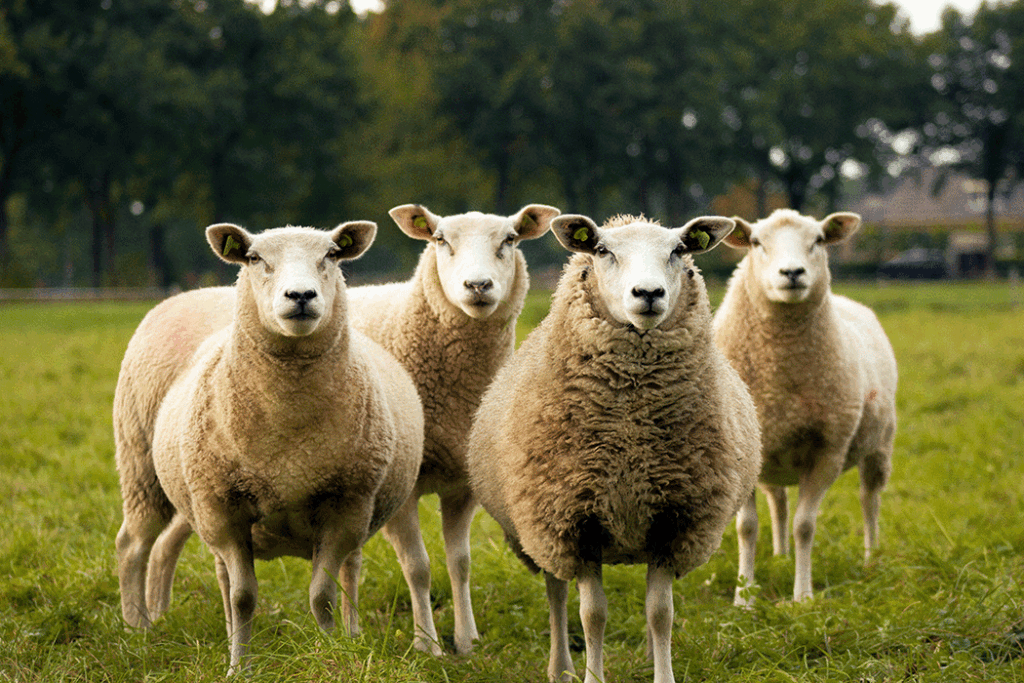
“We do a lot of due diligence to treat our animals with respect,” he says. “Our sheep get handled every morning and every evening when we milk them. In the spring, summer, and fall months, when we can graze, I take the sheep and cows out on the pasture. We lead our animals, we don’t chase them. They follow us, because they know we’re going to give them a good meal. That’s the way that works the best, too. I like to keep a calm, quiet demeanor with the animals.”
Working with a friend, Hershberger also specializes in certified A2/A2 milk—a milk that’s easier to digest because the A2 beta-casein molecule is closer to the protein structure of human milk. Originally, cow’s milk, like sheep’s milk, had only A2 beta-casein, but at some point, a genetic mutation in cow’s milk resulted in the A1 beta-casein protein, which is harder for humans to digest. A1 beta-casein protein often causes digestive distress similar to lactose intolerance, and is linked to inflammation, gut discomfort, and other health issues. Most commercially available cow’s milk is a mixture of A1 and A2 proteins. For this reason, dairy farmers increasingly specialize in producing A2/A2 milk. “Sheep’s milk is quite a bit easier to digest than even the A2/A2 cow’s milk, ” he adds, noting that many people who can’t digest cow’s milk have no problem with it.
Sheep’s milk, which is naturally A2/A2, is also higher in protein than cow’s milk while containing more short-medium chain fatty acids, which are easier to digest than the fatty acids in cow’s milk and can assist in lactose absorption. Sheep’s milk has a higher percentage of lactoferrin, which boosts the immune system and helps regulate iron absorption. It contains a number of bone-boosting minerals, including zinc, phosphorus, magnesium, vitamin K2, and approximately 36 percent more calcium than cow’s milk.
Maintaining farm integrity and keeping his customers satisfied are important to Hershberger. “We set our standards on what we consider a good-quality product. We always want to know if our customers feel they have not been treated correctly. A good product goes a long way into building a relationship, to keep our customers coming to buy.”
While Hershberger has been at the outdoor Fairfield Farmers Market in the past, family responsibilities may keep him from making it this year. He encourages people to pick up their orders from the farm. “I want our customers to see what we’re doing. I want them to interact with the animals and get an idea of what it is to eat good, clean food.”
Last summer, Iowa City resident Anna-Maria Cornell toured the Hershberger farm with her husband. “We have now tried the eggs, chicken, raw milk, butter, and other things, and they are superior to everything else we’ve tried so far,” she says. “Even more impressive than Allen’s love for the land and the animals was how he interacted with and treated his young sons. I would love to see their operation thrive.”
For more information, call the Hershberger farm (641) 242-0425.