
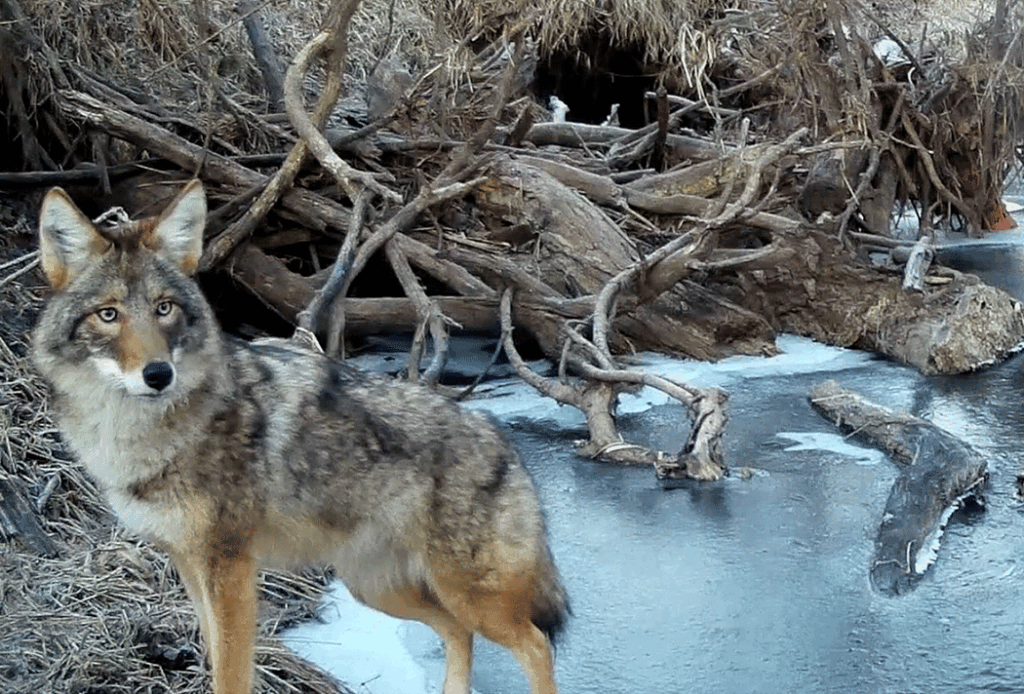
It was a highlight of my trail camera hobby. In March I posted a gorgeous 12-second early-morning clip from mid-January of a beautiful coyote walking regally down a frozen creek toward the camera.
It got over 24,000 views in the Iowa Critters Facebook group and many appreciative comments. But, but . . . two commenters asserted that it was generated by artificial intelligence and was fake.
So dispiriting.
After the second assertion, I told the person that the suggestion was painful and noted the huge amount of time that it takes to get a clip such as this. We have over a dozen cameras posted, and it can take hours to go through well over a thousand clips to find the best ones. I invited him to visit and see the location in person, and offered to send other clips from that spot.
Seven of the commenters gave my response a thumbs up. The thing is, once it’s suggested that something is fake, it creates doubt and diminishes the joy. The people in this Facebook group are nature lovers. They appreciated the reassurance that it was real.
Yet I gradually realized that the painful comment was understandable. AI has gotten so good that frequently it’s virtually impossible to tell what’s real.
Often on Facebook I see short videos called reels that look authentic. Like the grainy reel circulating a year ago of rabbits jumping on a backyard trampoline. It got millions of views across social media. I thought maybe it was real.
Of course, by the time I’d subsequently been deluged with similar videos of bears, deer, foxes, raccoons, etc., on a trampoline, I began to realize that much of what I see is fake. More recently, I’ve been seeing reels of a cat chasing off animals such as bears and mountain lions. The first time I was fooled, but as more reels with this theme appeared, I knew it was fake.
(Ironically, though, the cat trend actually began with a verified video of a cat in Tennessee that was in the habit of scaring black bears off a porch. Google tells me that black bears can be a bit timid and may flee from an aggressive, smaller animal.)
I’m now more sensitive to the possibility of fakes, but so often it’s simply impossible to tell. As I noted in an earlier column, the New York Times posted a quiz asking viewers to decide which of ten videos were real and which were fake. Each featured a person in a different setting talking to the camera. I couldn’t tell, and after completing the quiz, I had scored 50 percent—no better than chance.
It’s scary and disorienting not knowing what’s real, especially with the 2026 election season underway. Experts are concerned that deepfake videos could play a significant role. To help combat this, YouTube is expanding the availability of a likeness-detection tool that can help government officials, political candidates, and journalists detect and report AI-generated videos that impersonate them.
As I was writing this, I wondered if my old buddy ChatGPT could help determine if something is real. I gave it a screenshot of the coyote and asked if it was real or AI. It began, “This is a great screenshot—and in this case, I can give you a fairly confident answer: Very likely REAL (not AI-generated).” Yay!
It then offered an extensive and illuminating analysis related to the coyote, the environment, the lighting and atmosphere, and the camera details such as framing.
For example, it noted that the fur has “natural randomness—not the slightly ‘painted’ or overly smooth texture AI often produces. The face is anatomically consistent (eyes, muzzle, ears all correct and aligned). Subtle asymmetries (very important!) are present—AI often makes things too perfect. This looks exactly like a trail cam capture.” Yay!
Out of curiosity, I then gave a screenshot from my hugely popular bobcat video (118,000 views) to ChatGPT, Gemini, and Microsoft’s Copilot. All concluded it was authentic. Yay!
This is not to suggest that chatbots are the answer. At this point, there seems to be no definitive answer. But chatbots can be a good starting point, a quick way to get a sense for whether something is real. They can spot suspicious details, help check plausibility, and guide you to better tools such as fact-checking sites and reverse image search.
You can also ask a chatbot to survey fact-checking websites. Chatbots like ChatGPT and Gemini can quickly do multiple fact checks, highlight consensus, and summarize what they found.
I love chatbots. And for my friend who said he reads my column but doesn’t know how to access chatbots, you can typically access them via the web (e.g., ChatGPT.com) or download ChatGPT or Gemini or other chatbot apps to your smartphone or computer.
And . . . I love my coyote.
See the aforementioned coyote and bobcat clips at jimkarpen.com/trailcam.html.