
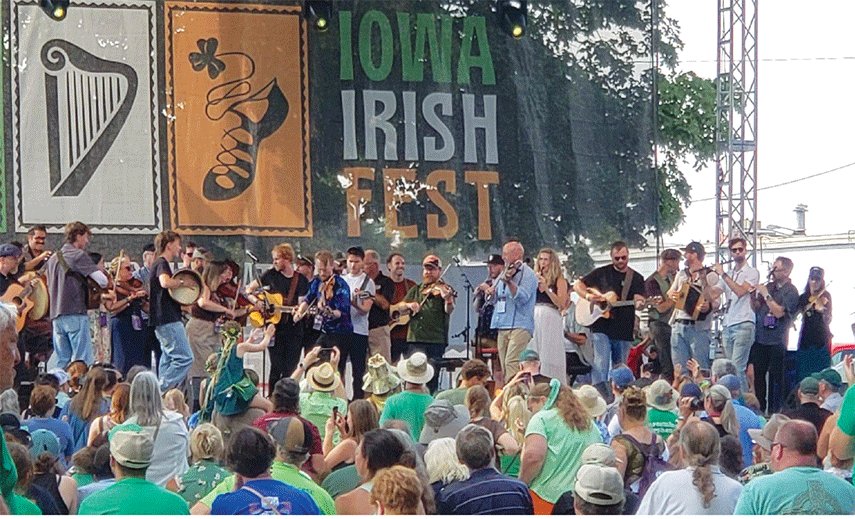
In 2025, my family attended Iowa Irish Fest downtown in Waterloo, Iowa, on Sunday, the last day of the annual three-day festival. We arrived early and gained entrance in exchange for cans of food for the Northeast Iowa Food Bank (we spent a lot on food and drinks, though). We set up our lawn chairs in front of the main stage and listened to Mass.
No, we’re not Irish, as far as we know. We just enjoy Irish Fest. And we’ve traveled to Ireland. Before and after my travels, I endeavored to learn all I could about Ireland. Something that revealed itself as I became exposed to the multifaceted reality of Ireland is that while the Irish are integral to the American story, Americans know little to nothing about the Irish story. I believe that the Iowa Irish Fest helps bridge that gap.
In early August 2025, Iowa Irish Fest’s comedic performer,“The King of Blarney” George Casey, faced a packed crowd in the cool, dark basement of Screaming Eagle American Bar and Grill. Before the show started, my son and I went to see what “The Guinness Experience” had on offer. There were placards of information about Irish history, quizzes to test your knowledge of all things Ireland, and a printer with edible ink to decorate the foam of your pint. At the bar in the back, one could acquire a flavored Guinness. I chose cranberry. Delicious.
*
Twenty years ago, while visiting Ireland, my friend Tim and his brother relished the quintessential Irish heritage when they walked into a shop in the small Irish town from which their great-grandfather and his brother had emigrated in 1855. They told a shopkeeper their surname and were directed to a farm, where out walked a relative who could have been their uncle’s twin. He was their distant cousin. The brothers spent time viewing homesteads, gravesites, and favorite pubs with their extended family. One such relative is Connie, and when I traveled to Ireland, Tim told her I was coming and she, being a dear, met me in Dublin.
Connie took me to Glasnevin Cemetery, where the leaders of the 1916 Easter Rising and many more national heroes are laid to rest. The Easter Rising was a military action against British rule, carried out with private volunteer armies and other organizations, including the women’s brigade. It was led by poet and Irish language teacher Pádraig H. Pearse, shopkeeper Thomas Clarke, labor leader James Connolly, and many other passionate individuals. Pearse wrote the Proclamation of the Irish Republic and read it aloud on the steps of the General Post Office after the revolutionaries occupied the building. It begins:
“IRISHMEN AND IRISHWOMEN: In the name of God and of the dead generations from which she receives her old tradition of nationhood, Ireland, through us, summons her children to her flag and strikes for her freedom.”
The nationalists overtook many municipal buildings in Dublin and other cities and towns throughout Ireland, but surrendered after a week of fighting. Fourteen of the 16 who had signed the Proclamation were executed by firing squad within two weeks. Their hasty deaths by military tribunal caused the Irish people, who had been divided, to coalesce in favor of independence from Great Britain, and in 1919 to take up arms and win.
When the War of Independence ended with the Anglo-Irish Treaty of 1921, there were terms that many could not accept, such as the partition separating Northern Ireland to remain in the jurisdiction of Great Britain, forming the United Kingdom; and the requirement that the Republic of Ireland swear an Oath of Allegiance to Great Britain. A civil war began, neighbor killing neighbor, until the anti-treaty faction called a ceasefire. Over 1,400 had died in 11 months—a sorrow passed down the generations that is still for some difficult to discuss.
In Northern Ireland, severe discrimination against the Catholic Irish continued. This motivated peaceful protests modeled after those of the American Civil Rights Movement. The marches were countered with force, and “the Troubles”—the violence—that ensued victimized both sides from 1968 to 1998. Republican (meaning those that stand for the Republic of Ireland as one country free from British governance) political prisoners protested criminal assignation and held hunger strikes led by Bobby Sands. Denied by Margaret Thatcher, ten protestors starved to death, which brought worldwide attention to their cause. The Good Friday Agreement, signed on April 10, 1998, replaced the violent struggle with a fair political process. The agreement is respected to this day, albeit with difficulties to work through, such as those implicit to Brexit economics and to legacy cases—unresolved crimes committed during the Troubles.
The Easter Rising of 1916 pivoted Irish history toward the end of British colonization. The blood sacrifice of those men, who died thinking they had failed, made manifest Pearse’s words that Ireland would once again have “her old tradition of nationhood” and freedom.
Iowa Irish Fest goers will likely hear “Grace” by Frank and Sean O’Meara, a ballad in which Joseph Plunkett, the 19-year-old Easter Rising revolutionary, wed his true love the day before his execution.
*
On the Trad Stage, an Irish-American band called Blame Not the Bard from Iowa City played churning fiddle tunes, pausing periodically for historical anecdotes.
In the Screaming Eagle, George Casey set the tone with silly jokes about his country, his family, himself. He wasn’t “stupid enough to discuss politics and lose half the room” and recalled a time when politicians could disagree and have a civil discussion over a pint. His jokes disparaged them all equally.
*
Of course, the Irish will be fine. Historically, the inhabitants of the island have survived raids by Vikings from the 8th to the 10th centuries, and incursion by Normans and then invasion of the English from the 12th century on. Relatively recently, Irish people were displaced and starved by the British during the Great Hunger of the mid-19th century.
*
For years, I experienced Irish Fest solely as time spent with my parents. I sat with them at their favorite stage, the biggest. Then one year I volunteered at a booth for the Cedar Valley Humane Society. After my shift, I discovered the smaller stages with varieties of music and activities, from solo harpists to pub sing-alongs and trad groups with bodhráns and accordions to step dancing contests. I found the rooms tucked away in neighboring buildings where things like tin-whistle lessons, language classes, and travel tips were offered. Strolling down Fourth Street to Lincoln Park, I saw fiber arts, blacksmithing, whiskey tasting, and Border Collie herding demos. I listened to the band Seo Linn give a powerful performance of the folksong “Oró, Sé do Bheatha ‘Bhaile,” familiar to me because Sinéad O’Connor recorded it in 2002. Irish Fest had me hooked.
*
Skip to Iowa Irish Fest 2025, where Davy Holden, in his “History of the Irish Language” seminar in the ballroom of the Elk’s Lodge building explained that Irish pre-dates English by 1,000 years and many English words are derivative. For example, “go leor” became “galore” in English. Holden recommended that travelers to Ireland find the original Irish place names in order to learn about their destinations, because in the process of Anglicization, semantics are disregarded. The city of Kilkenny is renowned for the massive cathedral at its center, but does the name Kilkenny hint at that history? Cill Chainnigh is the Irish name, with Cill meaning “church” and Chainnigh referring to “St. Canice.” The town surrounds St. Canice’s Cathedral.
After Independence in 1922, the Irish added public signage in their national language and compulsory Irish language courses in schools. Summer colleges in the Gaeltacht—the areas in the west where Irish is spoken as a first language—multiplied to teach the teachers who were suddenly needed for the obligatory courses. Over time, these colleges spread, adapted, and diversified, and now Gaeltacht coláíste (Irish schools) teach 25,000 students each year. A school called Coláiste Lurgan embraces technology and the arts to make language learning fun and relevant to teenagers. The musicians of aforementioned group Seo Linn were Lurgan students who went on to form the band after their English song translation project became a hit across Ireland. They sing traditional Irish music in pop styles, write their own songs, teach Irish, and perform at Iowa Irish Fest, all with charisma and compassion. Hearing young people at Iowa Irish Fest rock out in their elegant ancient language is ethereal.
*
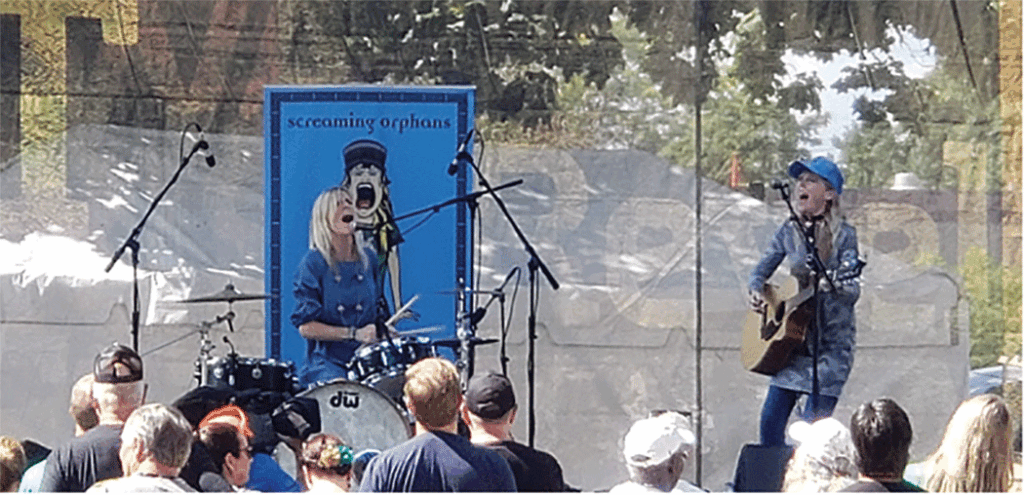
The Screaming Orphans, four sisters whose mother is a famous Irish trad musician, have been playing music together all their lives. When I’d heard them at Iowa Irish Fest in previous years, they seemed to be literally screaming as they rocked the main stage. But in 2025, they took breaks between each somber song to express words of compassion and encouragement for the audience. I told my dad it felt like rock ’n’ roll therapy, and I wasn’t complaining.
*
Originally, my soon-to-be-88 father said he would skip Irish Fest. But four days before the event, my mother phoned and said they would pick us up at 9:30 a.m. Perhaps they reconsidered after hearing the good weather forecast. We all agreed we’d stay only half the day.
My family stayed for the Scattering—the very last farewell of the festival when all the musicians who have performed on various platforms converge on the main stage, somehow synchronizing their instruments and voices for two final tunes. The term “the Scattering” is a reference to the exodus of people from Ireland beginning in the 1840s. They fled to countries around the world, creating the Irish diaspora.
Leading the way at the Scattering were the Byrne Brothers, a band of three siblings and their father. The vocalist played the bodhrán—a hand-held drum beaten with a carved stick using both ends—exquisitely. His brother played accordion, and their father and other brother played fiddle and guitar, while 30 or so more musicians followed along with tin whistles, banjos, guitars, fiddles, keyboards, and voices.
The crowd roared with applause, and someone on stage called out, “Thank you, Waterloo, we’ll see you all next year!”
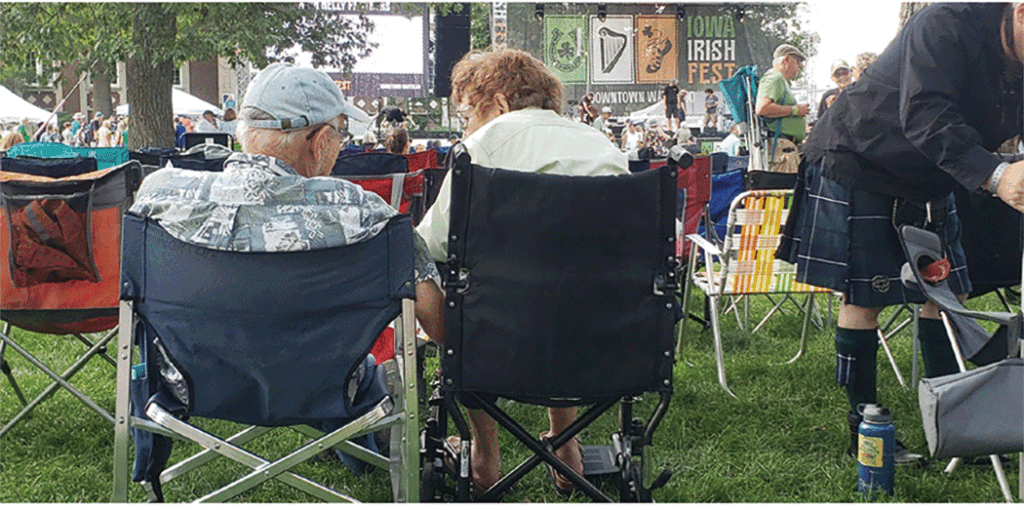
My son and I carried the folding chairs while my dad pushed my mom in her chair to our customary parking spot. Another summer of Iowa Irish Fest for the books.
Thank you, Iowa Irish Fest. See you in 2026!
Iowa Irish Fest 2026 takes place in Waterloo July 31–August 2. Visit IowaIrishFest.com.