
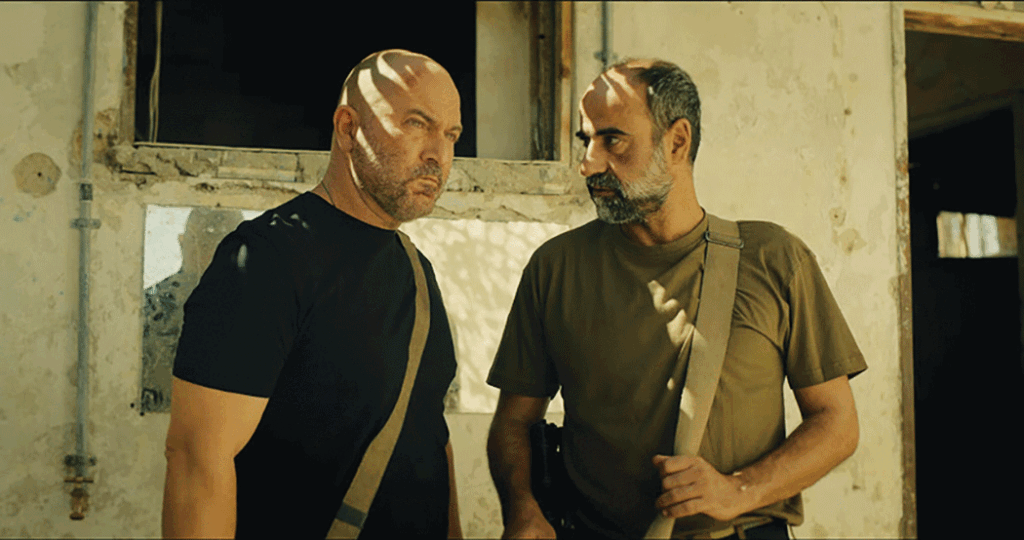
Fans of the first four seasons of the Netflix series Fauda (translation: chaos) might want to add to their watch list the unexpected 11-episode Season 5. Teaming up with journalist-screenwriter Avi Issacharoff, series creator, writer, and star Lior Raz ended Fauda in 2023. But when thousands of Hamas and Gaza terrorists attacked Israel on October 7, Raz resurrected the series and his character, Doron, for a fifth season.
Doron is the now-retired veteran of counterterrorism, fluent in Arabic and Hebrew. (Netflix offers English subtitles.) Doron’s friend Eli (Yaakov Zada-Daniel) asks Doron’s help in tracking the criminal who murdered his entire family on October 7. They both believed the killer was dead, but Eli has since learned he’s alive and living in Marseille, France. When Doron fails to change Eli’s mind about finding his family’s killer, he agrees to join him so his friend won’t be alone. The once-mighty Eli is in constant mourning for his family, and a broken man. Tracking the killer is the only purpose he has left.
We follow the two friends to Marseille, where they expect to locate their killer, do the deed, and return home. But secret missions are never simple, especially when you pretend to be from Gaza, playing for the other team. And there are hurdles, like getting recruited by terrorists to join their attack on the Israel border, which Doron and Eli are obliged to accept, even though it could get them killed. The business of exposing terrorists and achieving retribution is a dark and risky journey, but this moment might offer an intelligence upside, if they convincingly maintain their cover.
Meanwhile, Doron befriends a French woman named Anne (Mélanie Laurent). Anne joined the terrorist team as payback for the sudden kidnapping and murder of her husband Saeed el Hati (Hakim Djaziri), apparently by Israelis. Anne was stunned that anyone would have a reason to do this to her husband, a fine man and an ordinary accountant. Wasn’t he?
The season is filled with secrets, lies, and hidden identities of people we encounter or think we know. Doron’s life in counterterrorism was never discussed among his family, which took its toll on his closest relations, who were always kept in the dark. Now he and Eli are undercover, posing as Gazans on another secret mission. And once it’s over, it never happened, their lips are sealed. What happens in Marseille stays in Marseille.
Those who try to keep the world safe have intriguing but dangerous jobs with details that remain “in the office” while anxiety builds up inside them. Which explains why this series opens with Doron in a counseling session, foreshadowing PTSD in his future.
Fauda poses questions about the darkness in the world. Why is there so much hate that makes people kill innocent strangers? And why do these killers breed a culture that will murder people they don’t even know? We can all try to speculate. But would it help?
Since its establishment in 1948, Israel has been the tennis ball that gets bounced back and forth across the net of public opinion. But the huge popularity of Season 5, even in the Arab world, is a nod to Fauda’s more intimate presentation about people on both sides of the net that reaches out to both factions. There’s Eli, the Israeli who goes hunting for his family’s killer. And there’s Anne, whose husband gets killed by Israelis for a very personal reason. Like Eli, she is the grieving wife who is left behind. And that makes it painfully personal.
In the words of series creator Lior Raz (from a Sept. 9 interview in the New York Times), “I want them to look in my character’s eyes, and to see what we felt on those days. . . . If it would happen in their countries, they would feel exactly like we felt and how we feel about the world. So I hope it would open people’s eyes to see what happened on Oct. 7.”