
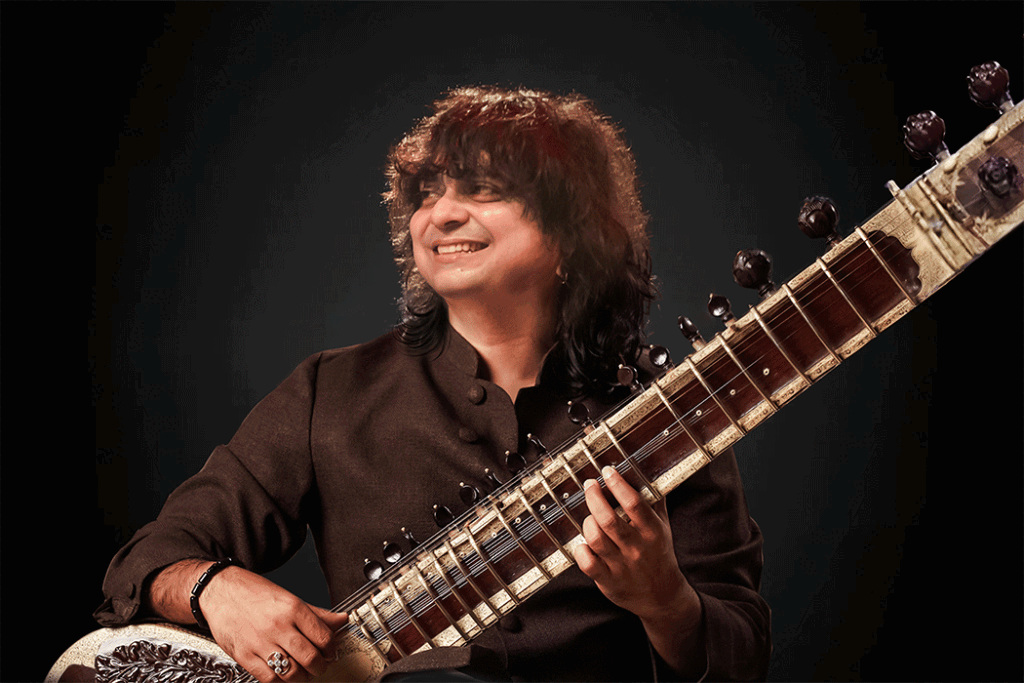
Whether you’re an aficionado of the emotive textures of Indian classical music or you enjoy its contemporary cross-cultural extensions, a rare “best of both worlds” opportunity awaits on Friday, October 16, when fifth-generation sitarist Niladri Kumaar will grace the stage at the Fairfield Arts & Convention Center at 7:30 p.m.
Space Between the Notes is the name of Kumaar’s concert tour and latest record, released in honor of his creative musical partnership with late tabla master Zakir Hussain.
If you were lucky enough to enjoy Zakir Hussain’s tour de force “Masters of Percussion” performance in Fairfield in March 2023, it was a magical evening of scintillating compositions and improvisation, blending ancient and modern styles and genres, flowing freely between cultures, all played with love, precision, and elegant transcendence. A dear musician friend recently told me it was his favorite event ever at the FACC theater.
The current tour features an ensemble of Indian and American musicians, including Satyajit Talwalkar (tabla), Agnelo Fernandes (keys), and Sambit Chatterjee (drums).
Regarded as one of the most popular musicians of his generation, Niladri Kumaar began playing the sitar at the tender age of four, giving his first performance at the age of six at the Aurobindo ashram in Pondicherry. He was trained by his father, Pandit Kartick Kumar, a senior disciple of the legendary Ravi Shankar. It was Ravi Shankar who brought the sitar to an eager generation of Western music lovers by inspiring a certain Beatle named George. The storied connection between George Harrison and Ravi Shankar represented a beautiful weaving of the old and new, the ancient and modern, expanding the concept of the crossroads. It is this tradition that Kumaar has embraced and expanded.
Like Zakir Hussain, who worked with such musical luminaries as Ravi Shankar, George Harrison, Van Morrison, Micky Hart, Bela Fleck, and Yo-Yo Ma, Niladri has collaborated with guitarist John McLaughlin (Mahavishnu) and jazz greats Herbie Hancock and Charles Lloyd, as well as composed music for many Indian feature movies.
Kumaar’s technical command of the sitar ranges from lightning-fast improvised melodic riffs (taans) to subtle string bends (meend), to stops and whispers and beyond. By bridging orthodox ragas to more contemporary settings, he has succeeded in enlivening the ancient melodies and engaging younger audiences.
He has received countless awards, including India’s highest national honor for practicing artists in music, dance, and theater—the prestigious Sangeet Natak Akademi Award.
But there’s more to the story. And it starts at the end of the alphabet.
Seeking a way to not be overpowered when playing with other musicians, Kumaar began fiddling (pardon the pun) with ways to electrify the sitar. He tried adding a mic pickup with some success but kept tweaking. After much trial and error, he decided to incorporate a shorter frame, flaming red in color, and to simplify the instrument from 20 strings to 5. It was another cultural bridge crossed—because now he could go toe-to-toe with anyone in any setting, from subtle musing to full-out jazz fusion.
He dubbed his invention the Zitar. Its first recording came out in 2008, called simply Zitar. In an interview with the Times of India, he summed it up this way: “Zitar is an electric sitar, it’s not an electronic sitar. Zitar is not a cross between a sitar and a guitar. It stands as a symbol of following one’s passion, taking the risk to venture the road less traveled, and finding what you completely love as that soon carves the essence of your journey.”
A few years prior to that, in 2004, it was his landmark release Sitar Gaze that would bring commercial acclaim and elevate his public reach, endearing him to a growing legion of fans. It broke all kinds of records in the Indian New Age fusion genre, melding Hindustani classical sitar with ambient lounge stylings, and it remains a popular fan favorite two decades later.
Humble, facile, evocative, and inclusive, Kumaar has called himself just a drop in the ocean of sitar music greats. His innovative approach to music (one of his earlier albums is called Sitar Funk) is carrying on and expanding the great tradition of world troubadour, something that would no doubt very much please the late, great, gracious Zakir Hussain, whom I had the pleasure of interviewing for The Iowa Source. Kumaar has spoken of having the “best seat in the house” when performing with Zakir, referring to him as divinity in human form.
Infinite is the Space Between the Notes.
For tickets, visit FairfieldACC.com.