
I was perusing an amusing little article I wrote exactly two years ago about eggs, my stab at contributing something for our March 2024 issue that was remotely springy or Easter themed.
And there it was. A four-letter word meant to articulate the “yellow, nutrient-rich, fatty part of a bird egg.” I say four-letter word because printed on the page, in unrectifiable, unerasable, undeniable ink, were the letters y-o-k-e. There are moments when you just want to die of shame.
Even worse, I discovered the same word had been misspelled not once, but three times, in said article. The stream of four-letter words that came out of my mouth next were much worse than “yolk,” though they all ended with a “k,” I assure you.
How many thousands of eyes had noticed that third-grade-level mistake!? How many of our loyal readers? How many of my former former high school teachers? Certainly my sister, who never misses a trick.
The month was just not starting off well. Minnesota was pretty much in flames, a huge creative project I’d been working on for months had come to a screeching halt, and I was suffering from existential grief like I’d never experienced. And then this. YOKE. Amateur hour.
I know, I know, in the scheme of things this spelling gaffe shouldn’t matter at all. There were 15,000 other words in that particular magazine issue that we got right. And although we are very proud of the work we do here, let’s be honest, it’s not like we’re Smithsonian magazine. No, no, they give those jobs to people who, unlike myself, have actual literature and journalism degrees, not just imaginary ones. I can’t help but measure myself against my high school classmate Jennie Rothenberg Gritz. Not only is she a senior editor at Smithsonian, but she’s publishing her first book before I do. Fine, Jennie. Take the win. My god, you deserve it. But let’s just remember who got the better grade in P.E.
What I’m trying to say is that there are mistakes, in publishing, with much higher stakes. Jobs with much higher pressure—and a much bigger budget—to get it perfect. I used to have one of those jobs.
The first job I ever applied for in my life was a proofreading job for a baseball card company called Mega Cards—formerly located here in Fairfield, Iowa. My 20-year-old brother worked there one summer as a graphic designer and encouraged me to apply right out of high school. After squinting at seven-point type for half an hour, I said “No way, José,” and slunk out the door. Funny how things come full circle sometimes.
Exactly 20 years later, in 2013, I landed a professional proofreading job by accident. For the 16 previous years, I’d worked all kinds of random gigs in Chicago as I attempted to support my theater-acting habit. I’d briefly assisted in a Northwestern University office that tracked shipments of crickets and rats and pigs being delivered to their animal research department. I’d answered phones for a boutique graphic design firm. I’d bussed tables for a European-style cafe. I’d performed in interactive children’s theater shows that taught anti-bullying skills. I’d recorded audio tracks for a series of online medical college classes out of my bedroom closet. I even went broke one year working a part-time, minimum-wage gig curating a small Lincoln Park gallery, of all things. But when my temp agency sent me to fill a reception job at a hip, high-end marketing firm with a view of the Chicago River, indoor bicycles you could use to cruise around the office (for real), and a never-ending supply of caffeinated fountain drinks, it was the first time I landed behind a desk and thought: “Ooooh, I wish I could get a real job here.” I got ballsy and asked. There was a job opening. For a freelance proofreader.
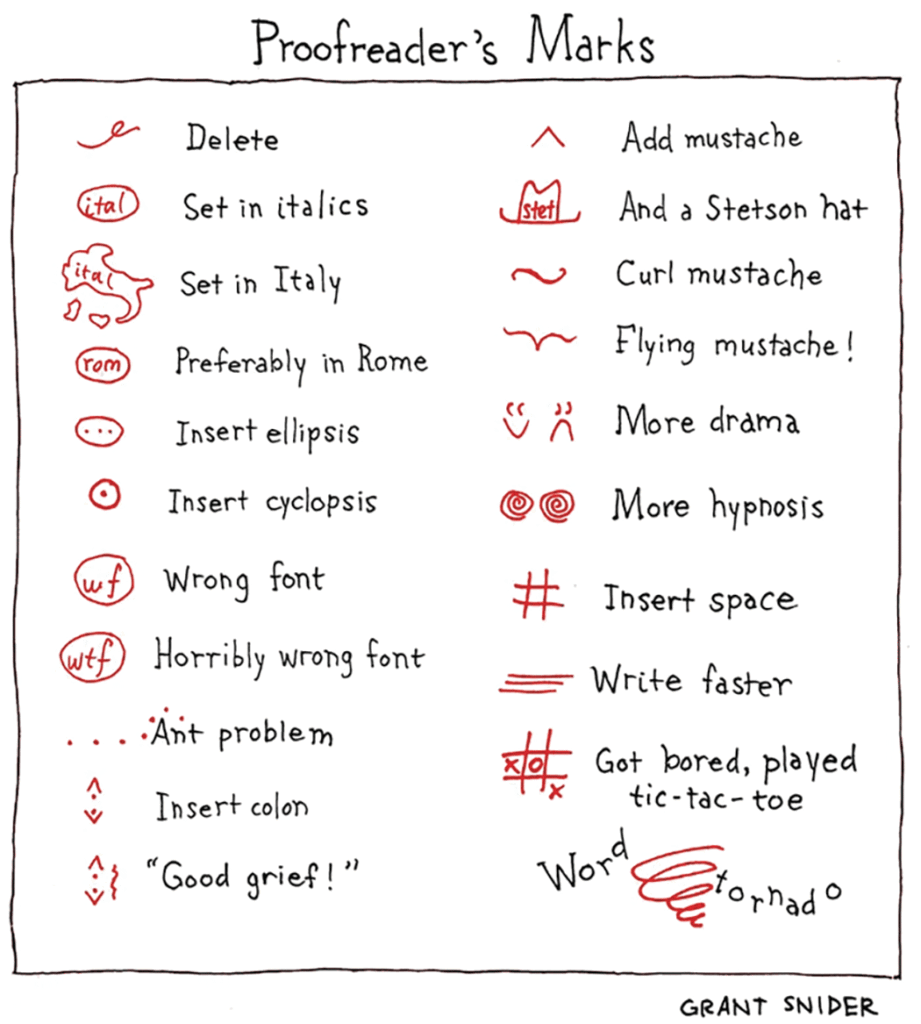
Everything I knew about proofreading I’d learned from my father, who’d critiqued my middle- and high-school papers with a red pen. Annoyed by the corrections, I was still fascinated by his little red strokes and slashes, triple underlines, and crimson loops that could lasso a misplaced word and corral it to a different spot in the sentence with a “caret,” a tiny pointed mark shaped like a carrot. I chose some decent words; Dad showed me how to bring them to a polish.
Although I had no business applying for this fancy job downtown, I picked up a copy of the Chicago Manual of Style after work and crammed for the next 14 hours. The head of the proofreading department, a studious, serious woman about my age, handed me a piece of copy paper upon which was printed an advertisement, in very small type, for an all-inclusive vacation package. “Experience the Magic of the Caribbean!” or some such. I was given the afternoon to try my luck with a red pen. It was a like a Where’s Waldo exercise, except Waldo wasn’t wearing an obvious striped shirt and glasses. I underlined and labeled and crossed out every possible error I could find, from missing periods to misaligned margins. When I handed the page back to the department head, I joked, “Either it’s the best you’ve ever seen, or you’re gonna wanna throw that thing right in the trash!” She came back an hour later and said, “When can you start?”
Before you can say “yolk,” I was proofreading ad copy for the firm’s big-wig international clients like Hilton Hotels, Proctor & Gamble, Subway, and Disney. There was a style guide used for each client, detailing the various ways they treated their products names, trademarks, and even whether or not they preferred an Oxford comma. Every ad, packaging label, and webpage design that came through the place was printed and proofed by us on paper; every new proof was stapled to the top of the stack of previous markups, for reference; and every page in the stack was approved and initialed by no less than four people. It was a well-oiled machine. And my boss was stellar at managing the work flow. I was paid for my thoroughness, always told to take my time, and—with the exception of one horrific day when the boss was out sick and an important client with a hard deadline was literally hovering over me, arms crossed, foot tapping—I was given the space, and the trust, to do a good job. As far as I know, no label on the back of any bottle of Head & Shoulders shampoo ever, ever had a typo on it.
The pay was excellent, but god, the days were long and the headaches were frequent. When the opportunity arose to move from a freelancer to a 45-hour-a-week employee with benefits, I shed some tears over the decision but eventually said no thank you. I knew that proofreading every day, all day, with no end in sight, was more than I could take long-term.
I took the money I’d socked away, planned to move to the mountains, but instead moved back to my hometown. When the editor of the magazine you’re currently reading randomly called me and asked if I wanted to write an article about a local Iowa hero, Mel Stockwell, who’d been saving antique letterpress equipment from the landfill, I was like … me?? … write? Did she have the right phone number? Was she confusing me with the other Meredith in town? The only things I’d written since college were theatrical skits, really bad songs, and even worse poems. I said, “Sure?” A year later, after she’d offered me the associate editor job for the third time, I took it. I figured she knew what she was doing even if I didn’t.
The page is now my happy place. And the word is my oyster. I’ve spent a decade exploring my voice as a writer, and during the remaining hours of each week, I get to put my anal-retentive tendencies and proofreading eye to good use in various other parts of our magazine.
But there’s a reason why a writer shouldn’t be tasked with proofreading her own work. Written words become her babies. And a mother is not only blind to her offspring’s flaws, but sometimes she’s been looking at that baby so long—holding it, and bathing it, and feeding it, and changing its diapers—that it’s best to put the kid in someone else’s arms for a while and hope it doesn’t eat too much junk food and play in the dirt.
In short, I must forgive myself for misspelling words or misplacing commas from time to time. We are scrappy over here, we are few, and we multitask like crazy. Although we have a couple sets of eyes that look at every page, just like all of you do at your jobs, sometimes we miss stuff.
The fact that you’re reading this now is a testament to your powers of forgiveness, dear reader. Thank you for not giving up on me. Eventually I’ll learn to spell. Someday I’ll know the difference between the object and the subject. Or how to explain why a comma goes here and not there. Or why I’ve decided I can get away with starting this sentence with the word “or” when my father would never have dreamed of such a thing.
I’m like you. I’ve got imposter syndrome, too. Half the time I’m just wingin’ it.
Wishing you all a Happy National Proofreading Day on March 8. Here’s to error-free writing! What a yoke.
P.S. If you find a typo in this article, I’m going to keel over.
