
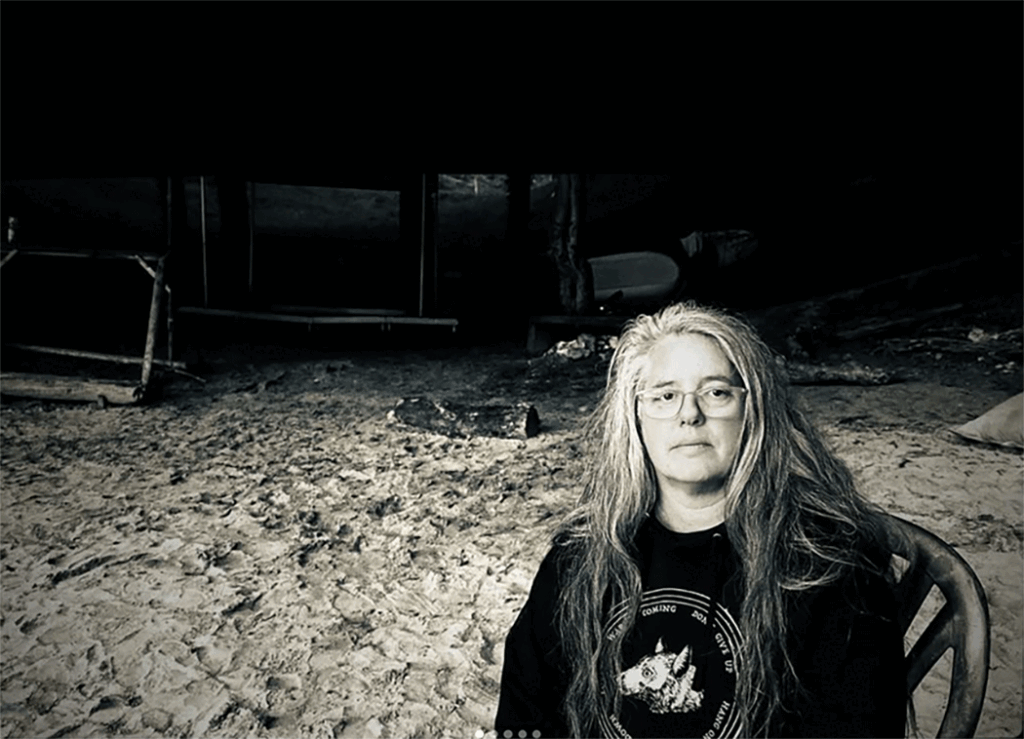
Marisa Anderson is an eclectic and electric guitarist who has toured with acts as disparate as country singer Emmylou Harris, apocalyptic post-rockers Godspeed You! Black Emperor, and avant-garde pioneer Thurston Moore. The Portland, Oregon, resident has released more than a dozen albums over the past 20 years. Her latest, The Anthology of UnAmerican Folk Music Vol. 1, serves as the centerpiece for her June 21 show at the James Theater in Iowa City, where she will perform five of its nine tracks alongside a mix of old and new material.
The inspiration for the new record stems indirectly from Harry Smith’s seminal 1952 Anthology of American Folk Music. The Smith anthology has been credited by folk revivalists of the early 1960s such as Bob Dylan, Pete Seeger, and Joan Baez as seminal to their music. Dave Van Ronk even called it “our bible” and claimed to know every word of every song on it. Anderson was born in 1970 and did not hear the album until it was released on compact disc in the 1990s.
“I had a friend who taped the CDs and we played it in the car while on road trips,” Anderson said. “I knew of the music’s reputation, but I was still surprised by how diverse the music was, from early jazz to gospel to blues to things that were unclassifiable.” She was duly impressed by the contents.
Years later, in June 2022, a chance encounter in Tulsa, Oklahoma, led Anderson to the Bob Dylan Center. Following a rumor that Smith’s personal record collection was housed there, she met the museum director, who confirmed the story and granted her a rare, ten-minute glimpse into the private archives. She was intrigued by the breadth of the collection, which included LPs from the 1970s and ’80s.
When she returned to Portland, she wrote a proposal that involved her researching Smith’s discs and creating her own collaborations with the music. It was accepted, and hence she created her own interpretations based on Smith’s record collection. “I had 10 days and 1,200 albums to listen to. I knew I had to focus and find music I would not have access to otherwise,” she said. She found the experience exhilarating.
She chose to call her album The Anthology of UnAmerican Folk Music Vol. 1 for a variety of reasons. First, her selections were from international (i.e., non-American) sources. Second, the music was from countries and regions that she was brought up to believe were the enemies of the United States: Vietnam and Southeast Asia, Russia and former members of the Soviet Union, and the Arab world. She noted that this album is Volume 1. She plans to put out sequels.
The word “un-American” has connotations related to the McCarthy era, blacklisting, and the notorious House Committee of Un-American Activities’ investigations of artists and other folk. While Anderson rejects the simplistic notion that she is an activist, she does consider herself a progressive and an active participant in the political process and protests that are often associated with Portland. She’s joined in multiple demonstrations concerning environmental issues, Native American rights, and the anti-nuclear movement.
Anderson is primarily an instrumentalist. She did put out one album several years ago that featured her singing, but says she does not plan on doing that again. Critics have praised her use of phrasing, sustain, and choice of tunings on the guitar as particularly expressive vehicles for conveying thoughts and emotions. This is more difficult than doing so with verbal language.
“I call it cadence,” the guitarist said. “Every person has a cadence in how they talk and walk. I use cadence in the same way a person is careful to use the right word, or a dancer uses timing,” she said. “What’s interesting is who is the arbiter. One might not be grammatically correct but communicate better by saying something an authority might consider wrong or improper.” That paradox is at the heart of what she does.
She finds the use of sustain to be especially helpful for articulation. This is the reason why she usually chooses to use an electric guitar rather than an acoustic one. Electric guitar sustain is the length of time a note lasts and can be controlled by several different methods. “I use sustain quite a bit in performance to create a certain kind of dynamics,” she said. She noted that audiences react instinctively to the sound or the lack of it during live shows. Silence can be just as effective when used purposely.
Anderson considers gospel to be the most expressive musical style and Pops Staples the master of intonation. She’s also a big fan of Malian multi-instrumentalist Ali Farka Toure and American guitarist Doc Watson. “I aspire to make sounds as beautiful as those artists,” she said wistfully, and cites them as major influences on her style of playing.
Categorizing Anderson’s style is difficult because she draws from such diverse sources. She suggests audiences listen with open ears. She’s performed in Iowa City before, at both the punk rock club Gabe’s and the more upscale Englert Theatre.
“I can’t control how other people hear my music,” she said. “I can only control what I think and do. My job is to get up and play. That’s what I will do.”