
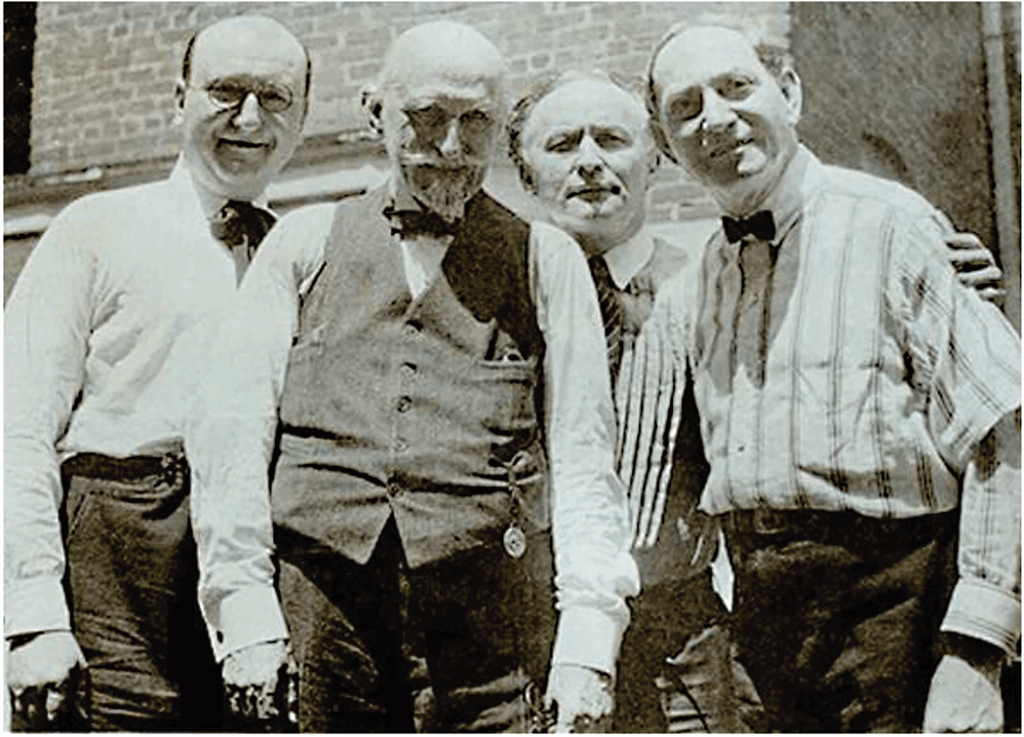
In 1897, the writer Edna Ferber and her family moved from Ottumwa, Iowa, to Appleton, Wisconsin, where she finished high school. After graduation, she worked as a reporter for the local newspaper, where she was assigned to interview the magician Harry Houdini, who had grown up in Appleton. Houdini was illusive, but she finally succeeded in speaking to him while the two stood on the street in front of a drugstore, next to a gum and candy machine.
During the interview, Ferber recalled, the two “chatted affably,” while Houdini leaned against the candy machine. When they finished talking, he dropped a cold metal object into Ferber’s hand. “There’s the padlock [to the candy machine],” he said. “Better give it to the drugstore man. Somebody’ll steal all his chewing gum.”
Ferber was wowed. As she later recalled, “I hadn’t seen so much as a movement of his fingers.” Houdini had been born in Hungary but ended up in Appleton because his father was the rabbi there. As a stage performer, he adopted his professional name in tribute to Robert-Houdin, the famous French magician. As his reputation grew, Houdini became well-acquainted with other prominent magicians, one of whom had also grown up in the Midwest, in the state of Iowa. That magician was Tommy Downs (whom Houdini initially met in 1893 at the Chicago World’s Fair), or—as his name appears on posters—T. Nelson Downs, the so-called King of Koins. Even his gravestone describes him as that.
Tommy Downs’s hometown is Marshalltown, Iowa, a city whose other claim to celebrity is that it is the birthplace of the film actress Jean Seberg, who, at age 18, was chosen to star in the film Saint Joan. If you visit the town today, it is imperative to tour the Marshall County Historical Society, at the corner of 5th and West Main. There, they have a cache of collectibles that pertain to T. Nelson Downs, notably including a strangely elaborate rocking chair (Italian from Victorian times), which museum guides refer to as “Houdini’s wife’s rocking chair.” While the origin of that title is unclear, it is said that Houdini’s widow (Wilhelmina, known as Bess), whenever she came to visit Downs, insisted on having first choice of that chair.
Downs’s fascination with sleight of hand began at age 12 when he first saw a magician perform. Four years later, he was hired as a night-shift clerk and telegrapher at the local railway station. When idle at the telegraph key, he practiced magic using coins and cards. Otherwise, when things were slow, he strolled out to the waiting room and demonstrated his sleight of hand to those who were waiting for trains.
On one occasion, among the passengers who watched his tricks was Fred Stone of the Stone Brothers, a circus acrobat and actor who would later play the Scarecrow in the 1902 stage version of The Wizard of Oz. More than a dozen years later, by which time Downs was famous, Stone was performing in London when someone told him he should see an amazing coin magician at the London Palace Theatre. “Well, however good this guy is,” Stone replied, “he surely can’t be better than a young man I saw years ago at a train station in Marshalltown, Iowa.” And, yes, it turned out that both performers were Tommy Downs.
It was Downs’s astonishing skill at coin manipulation that obviously earned him the label of the undisputed King of Koins. Among his best-known coin routines was the Miser’s Dream. In that act, as described by another magician, coin after coin was “picked out of the air, from various parts of the performer’s body, from the whiskers of some spectator, from a lady’s coat,” or they might “fall in a shower when someone sneezed.” At the peak of his career, he could palm as many as 60 coins.
Not only did he perform at the Palace Theatre in London (one time for 26 consecutive weeks), but he was so popular and well-known that he ended up performing on an all but continuous schedule from 1899 through 1912 on the world’s most sought-after stages, not just in New York and London, but also at the Folies Bergère in Paris and the Wintergarten in Berlin. He performed for royalty as well, including Queen Victoria and her son, the Prince of Wales (who would later become king).
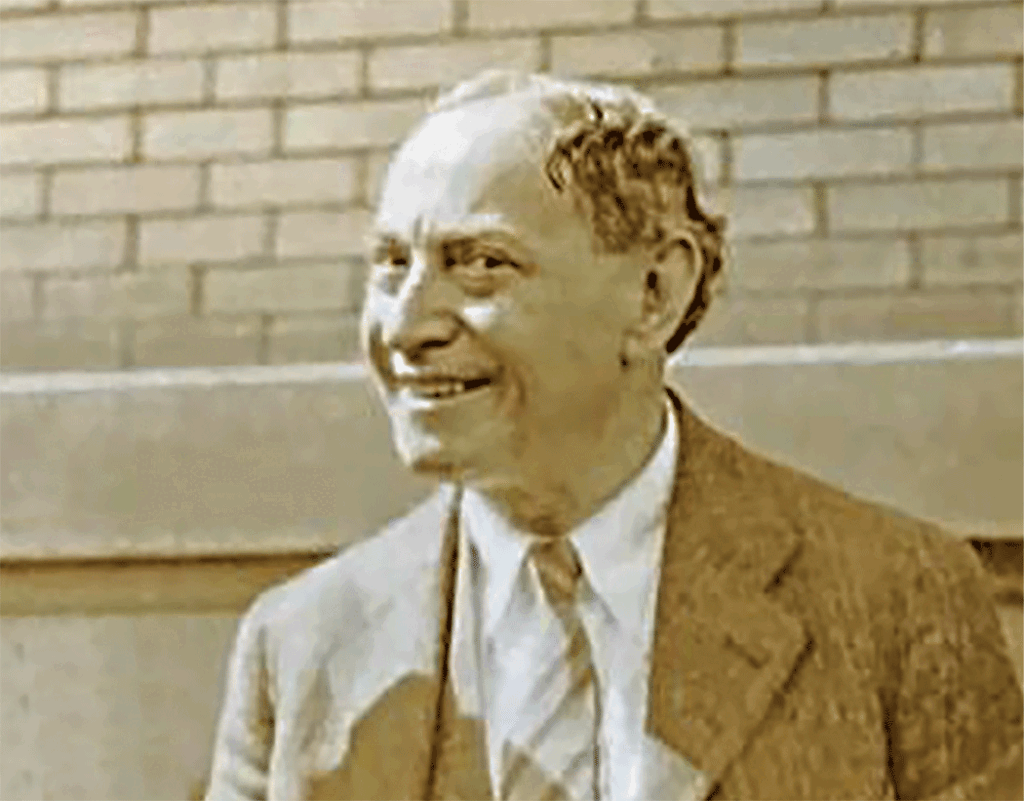
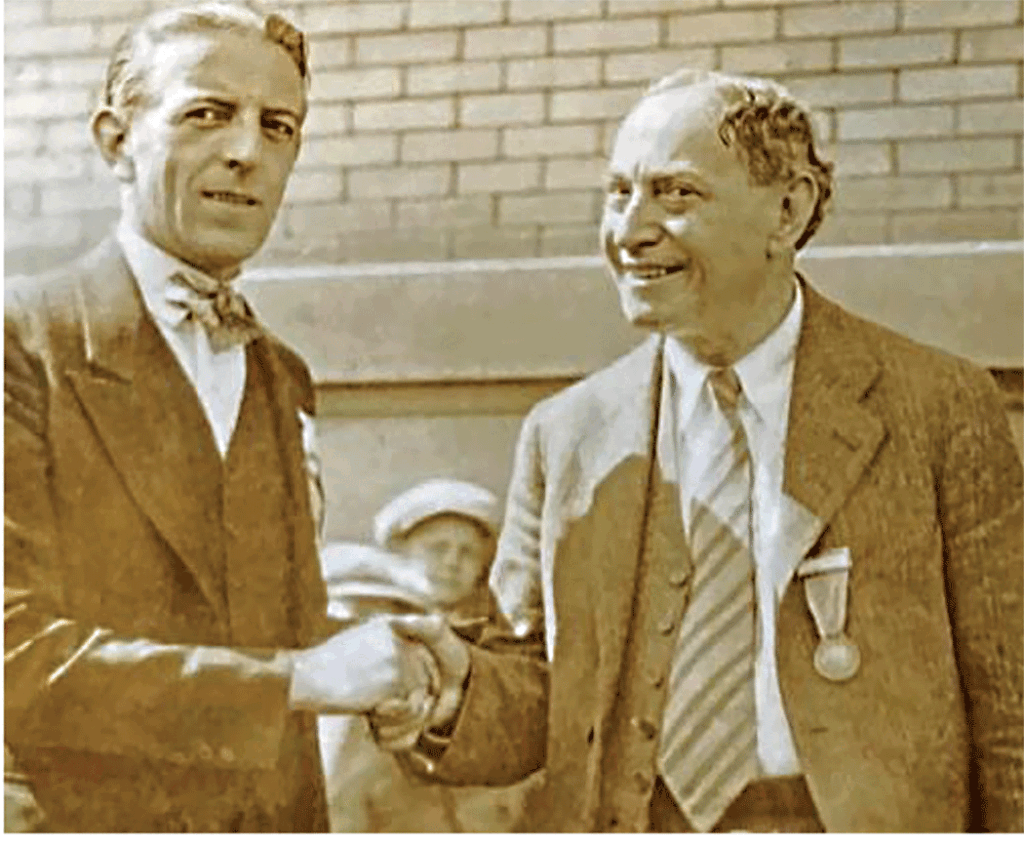
In 1912, at age 42, having earned what today is equivalent to more than a million dollars, Downs retired from the stage and returned to live in Marshalltown. But he did not retire completely. He bought a theater on Main Street where he sometimes performed, and opened a combined stage and motion picture theater in the same area. He also sold magic equipment by mail order, as well as the books he had written, and continued to participate in the Society of American Magicians. But his efforts were eventually slowed by the effects of an illness that started around 1935 (some say diabetes), and of course by the business disasters that came with the Depression.
As Karl Johnson aptly wrote in The Magician and the Cardsharp, Tommy Downs “had dazzled thousands around the world with his Miser’s Dream, pulling a seemingly endless supply of coins out of the air. But now in the Depression, audiences were longing for Pennies From Heaven. Downs was retired, and friends were sending him postage stamps in their letters to be sure he could afford to write back.”
His health was worsened by a stroke. He died in 1938 and was buried in Riverside Cemetery in Marshalltown, where some people leave coins on his tombstone.
I must share one additional note about Tommy Downs’s connection to Iowa. He married twice, first in 1890. But his wife died following childbirth in 1895, and he remarried ten years later. What is especially interesting is that his first wife was a woman from Marshalltown named Nellie Stone. She was the daughter of a Canadian immigrant and restaurant owner named Esbon Weed Stone.
Stone and his family had founded Stone’s Restaurant, a nationally known Marshalltown dining place, a literal family restaurant, that, while I was growing up, was located under the Third Street Viaduct. One of its specialities was “Mile High Lemon Chiffon Pie.” It was featured in Life, Saturday Evening Post, and National Geographic, and was praised by cookbook guru Duncan Hines. Its location was somewhat out of the way. With no GPS back then, travelers on the Lincoln Highway were told they could find it “Under the Viaduct, by the Vinegar Works.”
The author is especially grateful to Dorrie Tammen at the Historical Society of Marshall County for the help that she provided in learning about T. Nelson Downs. There is especially good information about Downs at TheMagicDetective.com.
Roy R. Behrens is a designer, writer, and retired university professor. In his youthful days, he dreamed of being a magician, but he only got as far as ventriloquism. The full story is online at bobolinkbooks.com.