
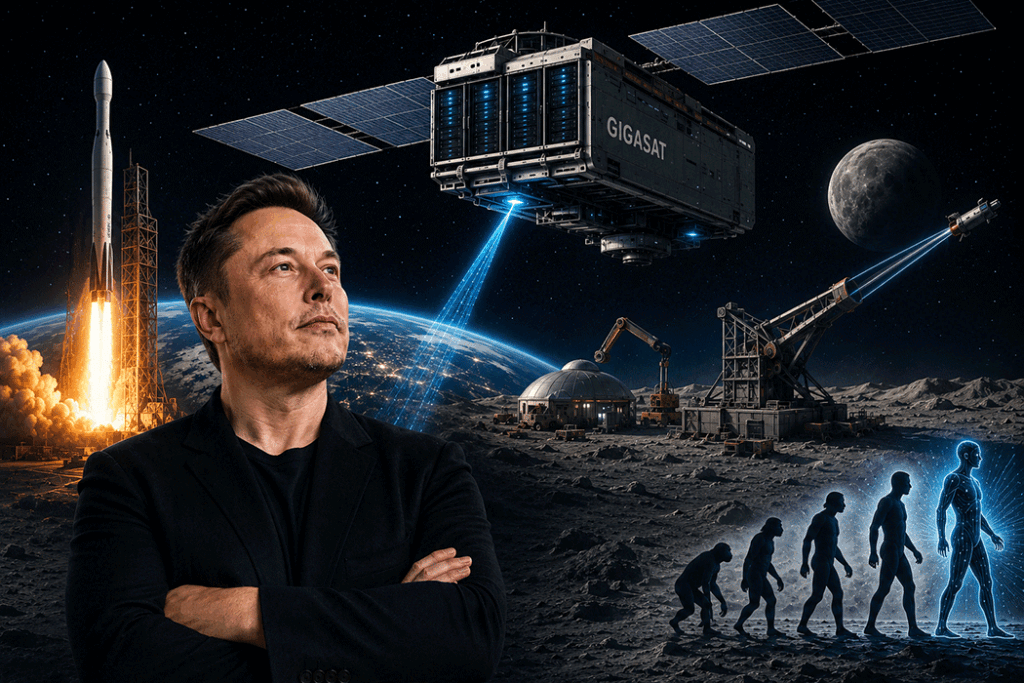
The huge data centers we use to access artificial intelligence are a problem. They tax the electrical grid, make heavy use of water resources for cooling, and generate noise. People are starting to object.
Elon Musk, the world’s first trillionaire, says no problem. We’ll just put them in space. Sounds a bit crazy, but this is the guy who created SpaceX, the successful rocket company, and Starlink, which builds satellites that offer space-based access to the internet.
Musk has now used his rockets to launch over 10,000 of these Starlink satellites into orbit, providing internet access to countries around the world.
His space-based data centers, called Gigasat, will be about twice the size of a Starlink satellite. The latest Starlink satellite is a metal object about the size of a dining room table, with the most recent model weighing about 1,760 pounds. Once in space, the solar panels unfold to a width of about 100 feet across, approximately the width of a basketball court.
Gigasat satellites will be far larger than Starlink satellites, with solar arrays stretching about 230 feet.
Construction has begun in Texas on an 11-million-square-foot factory that will build Musk’s Gigasat data center satellites. He expects manufacturing to be underway by the end of next year.
Give the guy credit. He had a vision to create a successful rocket company when others had failed that now handles over half of the world’s orbital launches. And his vision to make the internet available to everyone in the world via satellite is a reality.
Now he wants to put data centers in space.
But, frankly, I can’t get my head around his next step: Musk says his company will eventually manufacture his AI data centers on the moon. And will launch them into space using a giant electromagnetic catapult.
Seriously.
The moon actually has most of the raw materials needed to build the satellite’s heavier components, such as iron, aluminum, titanium, and magnesium. It is also rich in silicon, which is the primary ingredient in solar panels.
And the catapult? Musk feels that it won’t be necessary to use a rocket to launch the satellites manufactured on the moon into space because the moon has less gravity and no atmosphere. Just sling them out there with a catapult.
His vision doesn’t end here, of course. Outer space is, for him, a region filled with natural resources just waiting to be exploited. Jeff Bezos, founder of Amazon and the Blue Origin rocket company, has a similar vision. His company is also working on technologies that will take advantage of resources on the moon and asteroids.
Bezos feels that the development of reusable rockets, plus the forthcoming exploitation of space-based natural resources and the new space-based communication technologies, will allow polluting industries to move to space.
He is facilitating this, he says, by building a road to space. “The job of a company like Blue Origin is to help build the road to space, that heavy infrastructure, so that many other companies can do incredible things.”
If you think this is a bit out there (so to speak), it gets worse.
The AI tech overlords envision a “transhuman” future. Their deep immersion in artificial intelligence forces them to consider what it all means. And for Elon Musk, who also founded an AI company called xAI, it means that our destiny as humans is to create a superintelligence. Last year he posted that “it increasingly appears that humanity is a biological bootloader for digital superintelligence.”
A “bootloader” is low-level computer code that boots up your computer so it can run sophisticated programs. Humans are bootloaders preparing the way for a superintelligence.
The tech overlords also sometimes ponder a merger between humans and AI, as did Sam Altman, CEO of OpenAI, in a 2017 post. He felt that as AI exceeds human intelligence, becoming more competent and more powerful, it could lead to a conflict between the two species. He wrote that the best case scenario would be a merger between the two.
Elon Musk actually has a company, Neuralink, that’s developing a technology that directly connects a computer to a human brain. The initial goal is to help people suffering from brain disorders. But in addition to helping these individuals regain autonomy, the company’s mission is also to “unlock human potential tomorrow.”
According to Musk, the company’s long-term goal is to achieve “a symbiosis with artificial intelligence,” and he has warned that otherwise humans could be “left behind” as AI advances.
There is even a vision among some of the tech leaders that this merger between AI and human consciousness will expand into the universe, the role of humans being simply to birth this new, nonbiological species.
Frankly, I’m happy with my brain as it is.