
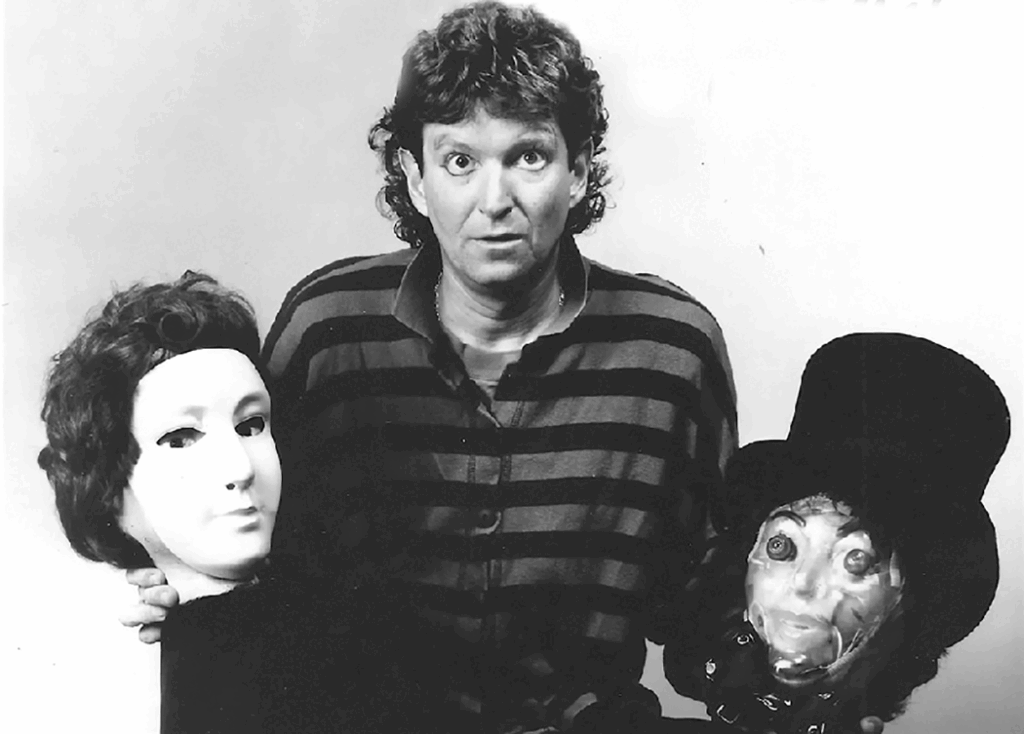
The following is an excerpt from Fax Gilbert’s 2026 book, “What Can I Say? The Art of Creative Misadventure” (available on Amazon), which follows his merry but mishap-filled career of bringing mime performances and theatrical workshops to schools across the country.
Children love going to festivals and fairs, and I was no different. The rides, the people, the food, and the excitement of just being there were exhilarating! During the summer months, when schools were closed, I started including some festival performances to supplement my staples of library programs and theater events. I quickly discovered that performing at festivals was very different from attending festivals.
Festivals quickly became my least favorite venue. The local committees that set them up certainly had the best of intentions but often overlooked the challenges that being outside can bring to performers, as well as patrons. One festival I worked in Nebraska was set downtown amid the asphalt streets. As I set up to perform, I noticed that the local bank sign’s temperature reading was 104 degrees. I also became aware, as I squinted into the sun from the stage, that my audience was gathering in the welcome shade of some trees, some 50 yards away. This did not encourage the audience participation that made up half of my show.
Another prime location chosen for one small town’s 4th of July festival was the local high school football field. The stage was placed in front of rising bleachers set behind a 20-foot chainlink fence that separated the audience from the stage, except for one entrance door. I didn’t ask why the fence was there, thinking that perhaps the locals were a bit rowdy at football games, and I began to appreciate the fence as a welcome shield from the possibility of flying objects.
The stage itself was a mix of wood and metal scaffolding. Just before showtime, I noticed that an array of lightning storms was moving closer. It crossed my mind that the metal fence in front of me and the stage I was standing on were just the kind of juicy surfaces that lightning loves to strike. As I was being introduced, tomorrow’s headline raced across my mind, “MIME BARBECUED AT FOURTH OF JULY FESTIVAL!”
I was moving through the show at a good clip when the sound of thunder cracked through the sky. My audience didn’t move. They were there for a show and, by gum, they were going to see it! The thunder came closer—or was it the sound of my pounding heart? I cut my finale in half just as the wind picked up and the rain began to fall. Only then did the audience rush to squeeze through that one door in the fence. We cemented our connection by sharing the experience of being soaked together . . . and living to tell about it. It took me a few days to dry out my props and equipment. A small price to pay.
In addition to challenging locations, I also experienced unwelcome noise from food trucks, vendors, and games, as well as the occasional inebriated onlooker—a toxic mix that made many of my festival performances memorable.
The annual Iowa State Fair is the largest fair in the United States, with more than 100,000 people visiting daily over its 11-day duration. It’s held in mid-August, usually the hottest and most humid time of the year, with temperatures regularly reaching into the 90s. I would be outdoors in the sun and wind and rain with no cover, just like my audience. In retrospect, I often question why I signed a contract to present 33 45-minute shows over 11 consecutive days at a venue where even one day could be physically and mentally challenging.
On my first day, it was with an innocent optimism that I crept along through slowly moving traffic toward the Iowa State Fair. My performance area was a natural amphitheater overlooking a small stage where a couple of hundred fair-goers could sit on benches to watch the shows from an intimate distance. All good.
I soon met the other performers who would rotate shows with me: a sweet couple from Colorado who had created an animal act with their two potbelly pigs. These pigs were the headliners, having appeared on the Leno and Letterman late-night talk shows. There was a black pig named Bacon and a white pig named Porkchop. The pigs weighed in at 35 pounds each and had a self-possessed air of condescension about them, befitting their status as stars.
This impression was reinforced when I entered the only air-conditioned room of our trailer and quickly realized from the pigs’ screeching and possessive demeanor that this was their room—do not disturb! As I slunk into the living room, I realized that, in moments like this, one may begin to inquire into the reason for one’s existence and the question may arise, as it did for me, “Who am I and what the f*** am I doing here?”
The pigs would recline on their bed between shows, and we gradually developed a working, if not cordial, relationship. They even let me slip into their room to use the trailer’s only bathroom with but a few begrudging grunts in my direction.
My show was ideal for these family audiences, and it was well received. The pig act was a hit, as the porkers displayed surprising intelligence and mastery as they kicked soccer goals, moved to music, and even imitated certain celebrities’ distinctive body language. My favorite was when Bacon was given dark, wraparound sunglasses and, with his front hooves up on the box, would move his head from side to side to Stevie Wonder’s “I Just Called to Say I Love You.”
As the days passed, one show merged with the next and I began to look forward to the changes in routine caused by thunderstorms, gusting wind, and audience behavior. To cool off from the stultifying heat, I would visit the Butter Cow exhibit, where a life-sized cow sculpted out of butter stood in a well-refrigerated area. I was surprised at how long the fair-goers would stare at the cow as if waiting for it to do something—which, thankfully, it never did.
Nearby was a livestock building where animals would be judged for ribbons. At the bull competition, I saw a bull from Texas standing motionless in the heat. Named “Big Boy,” this bull weighed 3,500 pounds, looked to be the size of two compact cars, and sported basketball-sized balls that hung down to just several inches above the floor—one of the many oversized attractions I found at the fair.
As we moved into the final and eleventh day of the fair, I could feel the energy from all the performers and vendors shifting to going home or the next whatever. I sensed that even the pigs were growing testy and longing for the familiar comfort of their Colorado environs.
As I went through the motions of re-packing my props and equipment, I briefly fell asleep and realized just how tired I was—barely running on fumes of relief that the fair was finally over. I was too exhausted to drive the 125 miles home, so I decided to spend one more night at the hotel and get some rest. I stopped at a convenience store for bottled water and saw a container of cigars on the check-out counter. On a whim, I decided to buy a cigar. Why not celebrate? This led to another idea: Why not buy a pint of brandy and really celebrate? So I did.
As I rode the elevator up to my room on the ninth floor, I could barely stand. Once settled in, I lit up the cigar, poured some brandy, and leaned back against the headboard. The last thing I remembered was a feeling of profound relaxation as the light of my awareness slowly dimmed, as if by rheostat. Over and out.
I awoke hours later to the stench of old cigar smoke and a sore throat from hell. I was sick for most of the following month and had to cancel or re-book many programs, thus erasing much of the income from my 11 days at the fair.
Seen in the best light, the Iowa State Fair was a learning experience. I learned to avoid prolonged exposure to extreme heat, venues of 100,000 people, and festivals lasting more than a day. I experienced the humility and identity death that come from opening for a pig act, and finally, I learned that decisions made when the discernment process is clouded by fatigue rarely work out well.
Pick up a copy of Fax Gilbert’s book on Sunday, August 16, at 2 p.m. when he gives a reading at the Fairfield Public Library.