
Nashville is America’s unofficial capital of the bachelorette party, the pre-wedding bash meant to celebrate an upcoming marriage. Perhaps that’s why it’s appropriate for the town to be the home of AmericanaFest. After all, many pundits describe Americana music as a marriage between roots rock and old-time country, though the genre’s family tree extends well beyond those traditions.
The modern Americana movement began during a time of strife in the late 1960s, when mainstream country and popular rock cultures were separated by political ideologies. Country artists stood for conservative values and supported America’s involvement in Vietnam, while rock musicians stood for progressive social causes and opposed the nation’s participation in the war.
Some acts, such as the Band, Creedence Clearwater Revival, and the Byrds, embraced both traditions despite being lambasted for being too country for rock or too rock for country. Americana resulted from this wedding of styles. The first official convention of the Americana Music Association was held in Nashville in 2000, and the festival has grown bigger and stronger every year.
AmericanaFest 2026, held September 14–19, featured more than 200 artists spread across 50-plus venues. Obviously, I could not witness every show, so I’ve reviewed my personal favorites.
To celebrate this happy marriage of musical styles, reciting the traditional marital rhyme seems in order.
Something Old
Robert Plant received the Americana Music Association Lifetime Achievement Award at this year’s awards ceremony for his long-time contributions to Americana traditions. The 78-year-old sang a rousing version of the 100-year-old African American spiritual “Satan Your Kingdom Must Come Down” in a weathered voice that expressed the importance of perseverance in a troubled world.
The performance underscored Americana’s deep connection to musical tradition. Other older artists performing this year include the 87-year-old folkie Judy Collins and 84-year-old soul legend Swamp Dogg. There were several artists in their 70s, including slide guitar master Sonny Landreth, roots maven Buddy Miller, and keyboardist Benmont Tench.
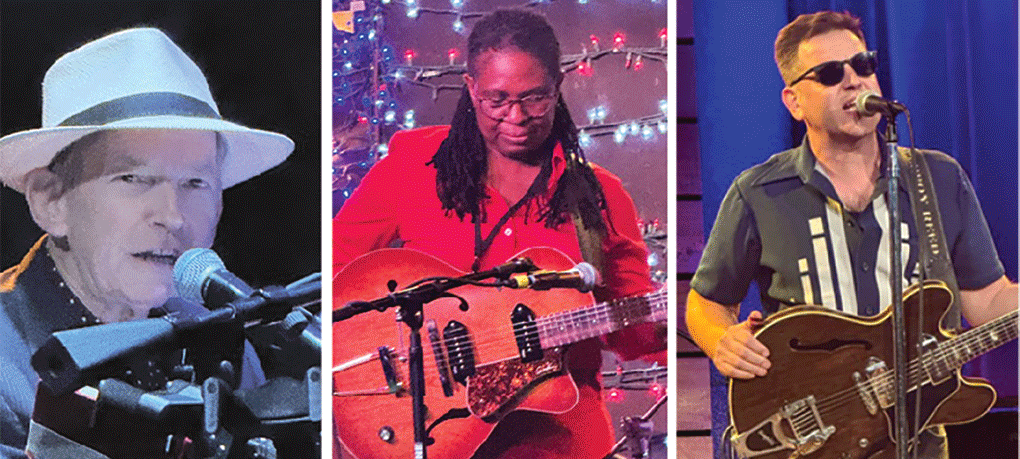
Tench was one of the fest’s outstanding live performers as part of the reunion of Tom Petty’s band, the Heartbreakers, when they received a Lifetime Achievement Award.
Something New
The 23-year-old Oklahoman Ken Pomeroy won the Best Emerging Act of the Year award and was just one of many marvelous young artists performing at the event. Several other young women created a buzz, including indie rocker Brennan Wedl, alt-country’s Angela Autumn, and singer-songwriter Tenille Townes.
At 17, Wyatt Ellis was the youngest person playing AmericanaFest. The Tennessee mandolin prodigy has already become a fixture on the bluegrass circuit. Other young men who made impressions included Alabama singer-songwriter Kashus Culpepper and Liberian folkie Mon Rôvia.
Something Borrowed
Traditionally, a guitar pull is a gathering where musicians pass around the instrument and take turns playing their songs. It isn’t done this way anymore—it’s more of just an informal gathering of musicians. This year’s Martin Guitar Pull opened the festival and featured a diverse group of artists, including country’s Brandy Clark, British singer-songwriter Jake Bugg, the rockin’ duo Marfa, and Tenille Townes. They all played short sets on new Martin guitars. One of the fest’s best moments was Clark premiering her new song “American Roots,” which boldly proclaimed that our country belongs equally to new immigrants as well as longtime residents.
SiriusXM radio hosted America’s Most Wanted Guitar Pull, which also featured Clark as well as Grammy-winning Texan Ruthie Foster, Southern rocker Maggie Rose, and the literary songwriter Kathleen Edwards. They sat on four stools and visibly reacted with awe to each other’s music. The two-hour program was one of this year’s finest shows and was broadcast live over satellite radio.
Something Blue
Blues remains one of the foundational languages of Americana, surfacing in everything from country ballads to Southern rock. Ruthie Foster and Sonny Landreth have strong blues connections, as do many other artists who played powerful sets, including the raw trio GA-20, the socially conscious Chris Pierce, and Southern rocker Duane Betts.
The most invigorating blues set belonged to Eli “Paperboy” Reed. His energetic performance with a six-piece band begged comparisons with the soul blues from a previous era (think Wilson Pickett and Otis Redding).
On the other side of the coin was the refined torch singing of Rita Wilson. Although better known as an actress and producer than a singer, she elegantly performed accompanied by two violins and a cello, two guitarists, a drummer, and a six-person vocal choir. She’s only been making music for around 13 years, and once asked Bruce Springsteen for advice on starting so late in life. “Creativity doesn’t follow a timeline,” he said, and urged her to continue.
And There’s More . . .
Presenting an overview of five full days of music and events is difficult. Consider the following list of best moments that also deserve mention.
Grace Potter gave a high-energy performance with explosive vocals, driving guitar solos, and frequent crowd interaction. She and her band’s cover of Tom Petty’s “American Girl” turned the folk-rock tune into a punk-rock anthem.
The Roy Orbison tribute was billed as “Black & White Night,” named after Orbison’s famous 1988 concert special. Erin Rae, Nicki Bluhm, and Kristina Train did compelling versions of the Big O’s music, but Nicole Atkins stole the show with her rendition of “Crying.” She started out wearing dark sunglasses during the evening performance, only to remove them at the end to show her tears.
The Official AmericanaFest After Party didn’t begin until late and featured local act Neely’s Band with a host of incredible guest stars, including Shakey Graves, Margo Price, Duane Betts, MC Taylor, and Michaela Anne singing songs from the 70s, such as Charlie Rich’s “Behind Closed Doors” (Michaela Anne) and “Picture Book (Shakey). Despite going way past the midnight hour, the energy never stopped.
While AmericanaFest may not literally be a wedding, by the end of the week the metaphor felt appropriate. Old and young, borrowed traditions and new ideas, roots music and rock and roll all gathered under one roof. In Nashville, the marriage still seems to be working.