
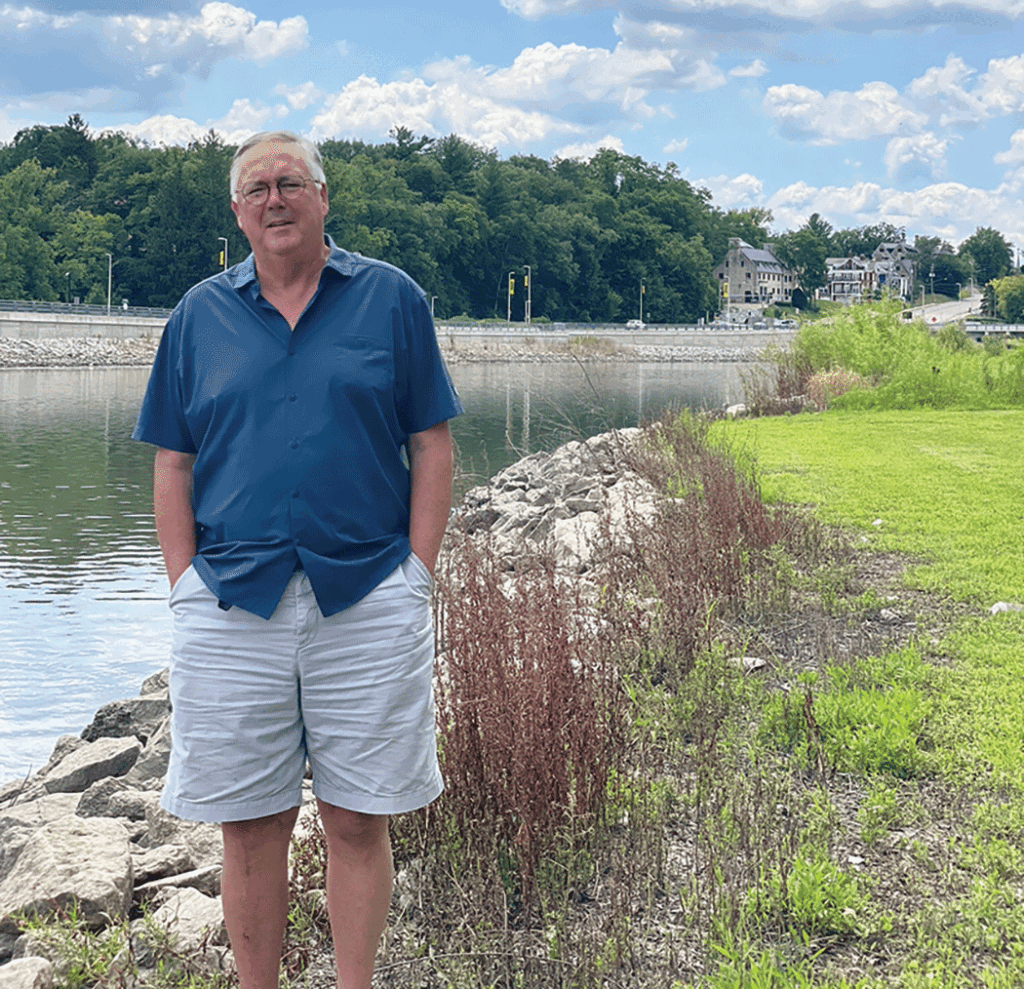
When I ask Chris Jones his favorite body of water, he doesn’t hesitate: the upper Mississippi. In the northeast Iowa Driftless area, densely forested limestone bluffs overlook a broad river valley. There, the Mississippi does not appear to be a single river, but rather many strands, many rippling blue ribbons that diverge around long narrow islands and rejoin, weaving for miles. Some islands are quite old and are forested, while others are ephemeral sand bars. Further south, the Mississippi has been narrowed and straightened, but in the Driftless it harkens to the early, wild shapes so many of Iowa’s rivers once held.
“It’s a paradise for sportsmen like me,” Jones says, for “fishing and hunting. Bird watching is phenomenal there. You can see hundreds of species of birds up there in the spring when the ducks are migrating. It can be really spectacular.” He tells me most people have never seen a canvasback duck, but he’s seen thousands on the upper Mississippi.
Jones devoted the last nine years of his career as an analytical chemist to studying the impact that Iowa has on the Mississippi River. All of Iowa’s streams and rivers, including the Missouri River, ultimately flow into the Mississippi. The Mississippi in turn flows into the Gulf of Mexico. As a research engineer and professor, Jones managed water-quality monitors throughout the state, tracking nitrate and phosphorus pollution from verdant fields all the way downstream to the more than 4,000-square-mile dead zone in the Gulf of Mexico. Along the way, toxic algal blooms, high nitrate levels, and E. coli from livestock manure routinely close lakes for public recreation. Animal waste and fertilizer result in fish kills each year. Iowa’s rivers, aquifers, and wells are polluted. The “sportsman’s paradise” of the upper Mississippi is in sharp contrast to Iowa’s more than 700 impaired waterways.
Running for Office
In spite of publishing 69 research papers, Jones felt his work as a scientist wasn’t having any public impact. “You’re still not affecting change out here on the landscape,” he told me in an interview beside the Iowa River, where he walks daily and sometimes goes fishing. “That’s what was frustrating, and ultimately, that’s why I became a candidate. I knew that just writing about this stuff was not going to be enough to make change.”
Jones is running for Iowa Secretary of Agriculture. The role oversees the Iowa Department of Agriculture and Land Stewardship (IDALS), which manages agriculture, consumer safety, and conservation, including water quality and the promotion of specific crops. Iowa’s current secretary of agriculture leads the hypoxia task force, a coalition of several states working to reduce pollution to the Mississippi and Gulf of Mexico. Secretaries of agriculture can also be influential in shaping the federal farm bill, which historically has had a far greater impact on Iowa’s farmers and landscape than any state-funded initiatives.
Addressing Iowa’s High Cancer Rate
One of Jones’s many campaign stops was a Clean River Rally in Emmetsburg, a northwest Iowa town in Palo Alto County with fewer than 4,000 residents.
Palo Alto County has the distinction of having the highest cancer rates in the state, nearly 50 percent above the national average. Iowa ranks second for highest cancer rate in the U.S., and rates of cancer have sharply increased since 2013, especially for young adults between 20 and 39 years old. A report released by the Harkin Institute and Iowa Environmental Council last March found the most common cancers in Iowa to be associated with pesticides, nitrate, PFAS, and radon.
I drive Palo Alto County’s two-lane highways and gravel roads, zigzagging along the west fork of the Des Moines River. The land is wide open, with shallow slopes in all directions. There are homes here and there, accompanied by small clusters of trees, infrequent islands in vast expanses of corn and soybeans. Every few minutes, I pass the long, pale metal barns of confined animal feeding operations (CAFOs).
Rain pools in fields after a brief morning thunderstorm. Narrow grassy green trenches wind between crop rows, silver lines of water moving quickly off the fields. In some places, corn or soybeans grow up to the river’s edge. Plastic pipes protrude from the bank, draining runoff from fields directly into the water that a dozen downstream communities rely on, including the city of Des Moines.
During Jones’s Q&A at Iowa Lakes Community College, a woman in the back row raises her hand. “I’m very, very concerned about our cancer. As a nurse practitioner, I know of over 12 people right now who either have pancreatic cancer or have passed from it. One of our commissioners has lost six people within a two-mile radius,” Maureen Horsley told Jones. She grew up on a family farm in Palo Alto county. “I know that’s a lot for a new Secretary of Agriculture, but how are we going to try to get that addressed?”
Jones doesn’t skip a beat. “We’ve known for 26 years that drinking high-nitrate water increases your risk for various cancers . . . colorectal cancer, thyroid cancer, prostate cancer, and some others,” Jones explains. “What do I mean by high-nitric water? I mean water [containing nitrates at a level] above 3 milligrams per liter. So the EPA standard [for nitrates] right now is 10 milligrams per liter. We know in Iowa there’s about a million people drinking water [with nitrates] above 3 milligrams per liter. So if you live in Des Moines, you have not consumed water [with a nitrate level] below 3 milligrams per liter basically your entire life.
“We know radon’s a risk too, right? But we have policy to deal with radon. We know nitrate’s a risk. Why don’t we have policy to deal with nitrate?”
Farmers Face Shrinking Income
If cancer is the downstream consequence of Iowa’s agricultural model, federal policy is the upstream cause. From World War I onward, the booms and busts of Iowa’s agriculture cycles—the waves of farm foreclosures and consolidations—have been driven by federal incentives, crop insurance, guaranteed markets for specific commodities, and abrupt withdrawal of these federal supports.
Stakes are high for farmers this election cycle. The 2026 Agricultural Outlook Report: The Pressure Is Rising reports that Iowa farmers have shrinking income margins for the third consecutive year. Crop farmers are losing money on corn and soybeans. Fertilizer, fuel, and equipment costs are at historic highs, while federal funding cuts and tariffs have reduced demand. The report concludes that the situation will not change unless policy changes, specifically an overdue federal farm bill. (The last comprehensive farm bill was passed in 2018.)
Jones says that the current system is designed to benefit “big, ungovernable, multinational corporations,” not farmers. “There’s been consolidation in agribusiness, so you have the effect of monopoly in agribusiness, and farmers are vulnerable to input costs.” Nitrogen fertilizer, corn seed, soybean seed, and pork processing are among the many sectors of agriculture where more than 40 percent of the market is owned by four companies.
“Big corporations love public policy the way we have it now, because it takes our tax dollars, funnels it through the farmers, and ends up in their coffers,” Jones said. “Let’s design a system that’s not reliant on public policy and is not designed to enrich corporations.”
Diverse Markets for Local Needs
Jones proposes creating stable markets for diverse crops, including oats, alfalfa, beef, fruits, and vegetables, and prioritizing nutritional and environmental outcomes. Strong in-state markets based on local need would give farmers greater independence from the erratic political swings of D.C. and the prices set by big agribusiness. Jones is quick to point out that 90–97 percent of fruits and vegetables eaten in Iowa are imported, and that Quaker Oats based in Cedar Rapids imports roughly 90 percent of its oats from Canada.
From a chemistry perspective, diversifying crop rotations to include alfalfa and oats and restoring pastured cattle and produce is simple math. When corn and soybeans are alternated, corn requires 100–150 pounds of nitrogen per acre, according to Iowa State University (ISU). Following alfalfa, corn requires only 0–30 pounds of nitrogen the first year and only 0–60 pounds of nitrogen the second year. In Iowa, oats are traditionally interplanted with alfalfa and clover, both of which suppress weeds and put nitrogen into the soil. Cattle grazed on pasture likewise require no nitrogen, and cattle feed typically includes alfalfa as well as corn.
Fruits and vegetables cannot tolerate common pesticides that have been linked to increased risk of cancers and found in Iowa’s waterways. When asked what he would do on day one if elected, Jones says he would create accountability for pesticide drift so that vegetable and fruit farmers are not vulnerable to having their crops wiped out.
The FAIR Farm Deal is central to Jones’s platform, and is also a standalone petition to encourage state funding for local food. Jones proposes dedicating $10 million annually towards locally sourced school lunches, with the goal of 50 percent local food in schools in ten years. This includes funding for food hubs, storage, processing, equipment, and delivery, all essential infrastructure for food growers to access Iowa markets such as grocery stores and hospitals as well as schools. In 2027, the recommended budget for Iowa Department of Agriculture and Land Stewardship (IDALS) expenditures is $325 million—$10 million is only 3 percent of that budget.
Local food initiatives consistently demonstrate strong returns on investment for tax payers. Depending on the study referenced, for every public dollar used to purchase from local farms, an additional .97 to $2.11 or more is reinvested in communities. This is called an economic multiplier effect, and applies to most locally owned businesses. The USDA’s local food impact calculator estimates a $22 million impact from a $10 million investment.
New Policies for Cleaner Water
Jones’s campaign often seems less like politics and more like a grassroots movement, with interactive Q&As, shared meals, and a 100-mile river float down the Des Moines River.
On that river float in September, a brief thunderstorm delayed the launch of the flotilla. By 9:30 a.m., the lightning had passed but there was still heavy rain. While everyone else waited in their cars, Chris Jones opened the long metal box on the side of his trailer and took out his fishing rod. The boy who grew up fishing with his grandfathers, uncle, and cousins, fascinated by frogs, turtles, water, weather, and nature as a whole, still engages directly with Iowa’s rivers and has invited others to do the same.
When the rain cleared, the flotilla launched into the shallow and calm west fork of the Des Moines River. Weaving through forested parks and wide open cornfields, abundant with birds, and dotted with plastic field tile spilling water from the morning rain, the river itself illustrated the beauty and vulnerability of Iowa’s waterways, and the relationship between those upstream and those downstream.
In order to have clean water downstream, Jones insists that farmers need support upstream, in the form of reliable markets and infrastructure, and state and federal funding and policies.