
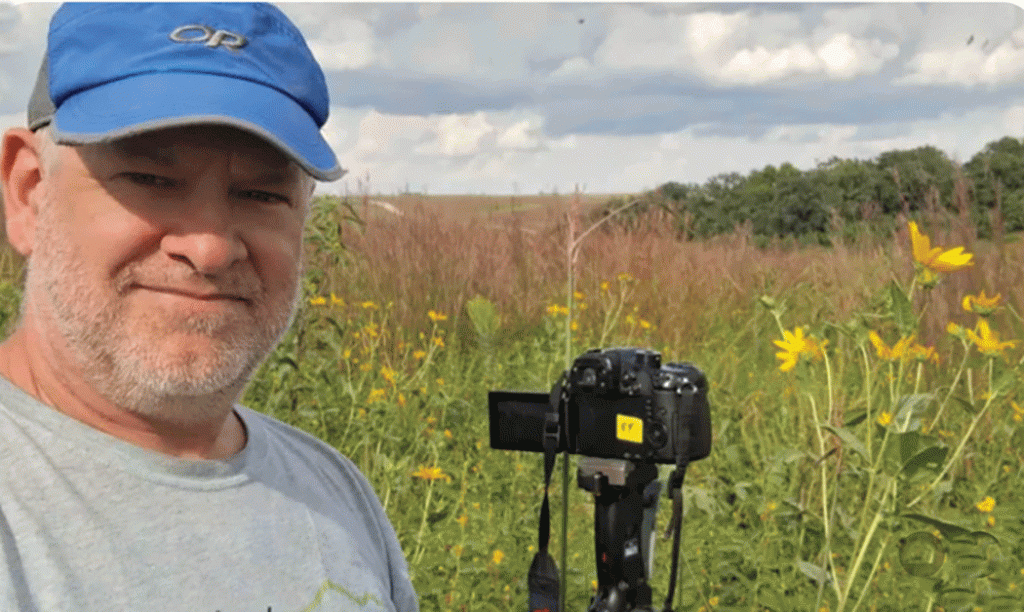
Iowa and the Broken Circle is a 90-minute documentary made by Iowa City filmmaker Charlie Morris as part of the Iowa Prairie Documentary Project. Since September, Morris has screened the film at dozens of theaters and small venues throughout the state. On December 3, the film will be available to watch on YouTube. To see the current schedule or organize a screening, visit Iowaprairieproject.blog.
Last night I saw Iowa and the Broken Circle again. I have to admit, the first time I saw it, I thought it was good. The second time, I thought it was great. That is not a small shift. Some movies get thinner when you already know where they are going. This one opened up.
You start noticing how Charlie Morris builds a scene, how long he lets someone sit in a silence that a Netflix editor would have cut, how the cello line does the work the narration refuses to do for you. Yes, it is different from other documentaries you or I might stream. That is because Charlie has his own style. I like that. I like anyone who is marching to the beat of their own drum, and I like Charlie.
He did not arrive in Iowa as a professional scold with a thesis already laminated. In August 2025, he was a newcomer asking two questions that a lot of people here treat as either too obvious or too dangerous: Why is everyone telling him not to swim in the rivers and lakes, and why are so many Iowans getting cancer? Those questions became the Iowa Prairie Documentary Project: a podcast, a pile of field videos, a Substack, an overspray reporting form, and then this feature. He has been doing it all as a donations-based volunteer. That part matters. You can feel the budget in the best way. Nobody bought him a second unit or a voice-of-God narrator. He drove, asked, waited, and edited.
If you know his earlier work, the through line is not hard to see. He came to filmmaking late, in 2015, on cheap gear, and pointed the camera at the places where land, water, and power meet. Prescott College is in his background. So is a long stretch in conservation work. The personal stake is even closer. His mother died in 2020 of a rare cancer that had been misdiagnosed for two years. By the time anyone named it, it was stage four. He has said, without theater, that she is one reason this movie exists. You do not need that fact to watch the film. Once you have it, certain cuts land differently.
The title is doing real work. A circle, in the old prairie sense, is roots talking to soil talking to water talking to plants talking to animals talking back to soil. Iowa broke that circle with extraordinary efficiency. Something like 97 percent of the land has been bent to the economy. What replaced the tallgrass is a system that can grow staggering amounts of corn and hogs and still leave you with water you are advised not to enter and a cancer-incidence rate that sits second in the country and is still climbing.
Charlie’s film is not a lecture about that statistic. It is a year of conversations with people who live inside it: prairie restorationists, water testers, researchers, farmers, the ones who will go on camera, and the many who would not, because they were afraid of losing a job, a grant, or a neighbor. He says that out loud. Conservation, it turns out, is a divisive topic in a state that markets itself as the picture of stewardship.
That is why the style feels the way it does. A conventional environmental documentary would stack b-roll of combine headers, a few graphs, a solemn expert, and a call to action before the credits. Charlie wanders. He will spend time on a prescribed burn until you understand fire as a tool, not a spectacle. He will put a shovel into a cornfield beside a prairie remnant and ask you to look at the roots. He will stand at Dunning Springs with someone testing nitrates at Iowa’s tallest waterfall, both a tourist spot and a drainage point. The interviews are long because the people are thinking in public. The original cello music, written and recorded by Anthony and Sarah Arnone in Iowa City, does not decorate the images. It sits under them like weather. You can tell he likes being outside with a camera more than he likes being in a studio explaining what you just saw. I like that, too. It places trust in the audience.
The second viewing is where the structure shows. First time through, you are busy taking in the argument: prairie gone, water compromised, bodies downstream. Second time, you notice the film is also about speech. Who gets to say what on the record. How a chemical that drifts onto a porch becomes a private problem instead of a public one. How a state can lead the country in corn and pork and still act startled that its rivers rank with the worst nitrate loads in the nation.
Charlie is not subtle about the science he has gathered. He has talked with people like David Cwiertny and Larry Weber and Carey Gillam and Thomas Rosburg. He has also talked with people whose names you will not find in a journal. The movie holds both without turning either into a mascot. That is harder than it looks.
The film does not care about manners. It also does not sneer. Charlie is not performing disgust at farmers. He is trying to look at a system that asks a few million acres to be one thing forever and then acts surprised when the water turns toxic and the clinics fill up.
If you have only seen the trailer, you have seen the first three minutes of the movie, which is a useful warning. This is not content. It is a person who moved here, asked an impolite question, and then kept asking it for a year while most of the official channels stayed off the record. He is making the movie he can make with the resources he has and the temperament he has, and that temperament is the reason the thing works.
I walked out thinking the same thing I thought in a smaller way the first time, only louder. People that didn’t get to see it really missed out. Not because the screening was glamorous. But because somebody in this state finally put the broken circle on a screen without sanding it down to a brand, and for one night in a hall that could have held a lot more of us, the picture was right there.
Visit Iowaprairieproject.blog.