
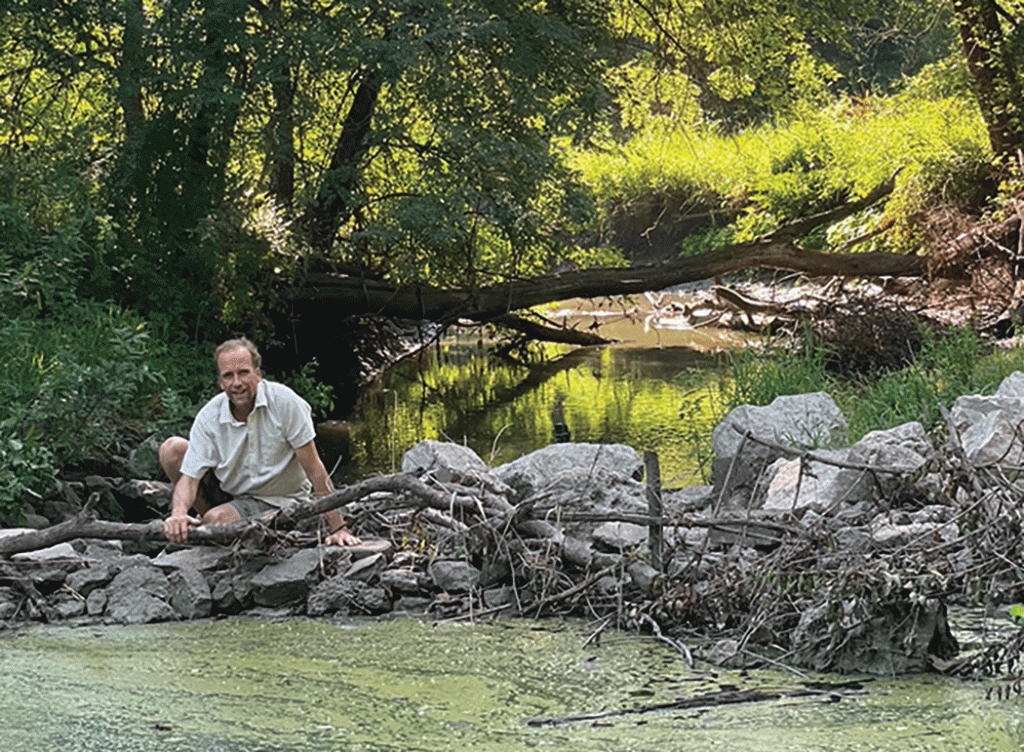
“It’s like coming into a beautiful nature paradise,” Noah Oullette says as we follow the curve of a long gravel driveway at the end of East Lowe in Fairfield and enter Harmony Forest. It’s a quintessential summer morning, with a bright blue sky, myriad birdsongs (we count more than a dozen species in minutes with the help of the Merlin app), and a startling tranquility. Intensely purple water lilies bloom across Beaver Pond, and berry brambles are interspersed with Queen Anne’s lace and small wildflowers in tall grasses. But the single most striking thing is a section of rock across Crow Creek: upstream, the water is murky and covered in a green film; downstream, the water is clear and mirrors the trees and sky above. The rocks are a type of beaver dam analog, or BDA, something Oullette specializes in building.
Harmony Forest is a privately owned park open to the public, stewarded by Oullette and his nonprofit, the Sustainable Community Development Association. With wooded slopes rising away from the pond and creek, Harmony Forest feels completely removed from the suburban east edge of town, even though it’s an easy walk or bike ride away. Situated along Crow Creek with the railroad tracks separating it from Chautauqua Park, the property helps to extend the contiguous habitat and wildlife corridor along Fairfield’s Loop Trail. Even semi-aquatic animals like beavers can swim or waddle their way from the Neff Wetland, where Crow Creek and Troy Creek merge. For beavers, waterways still serve as highways.
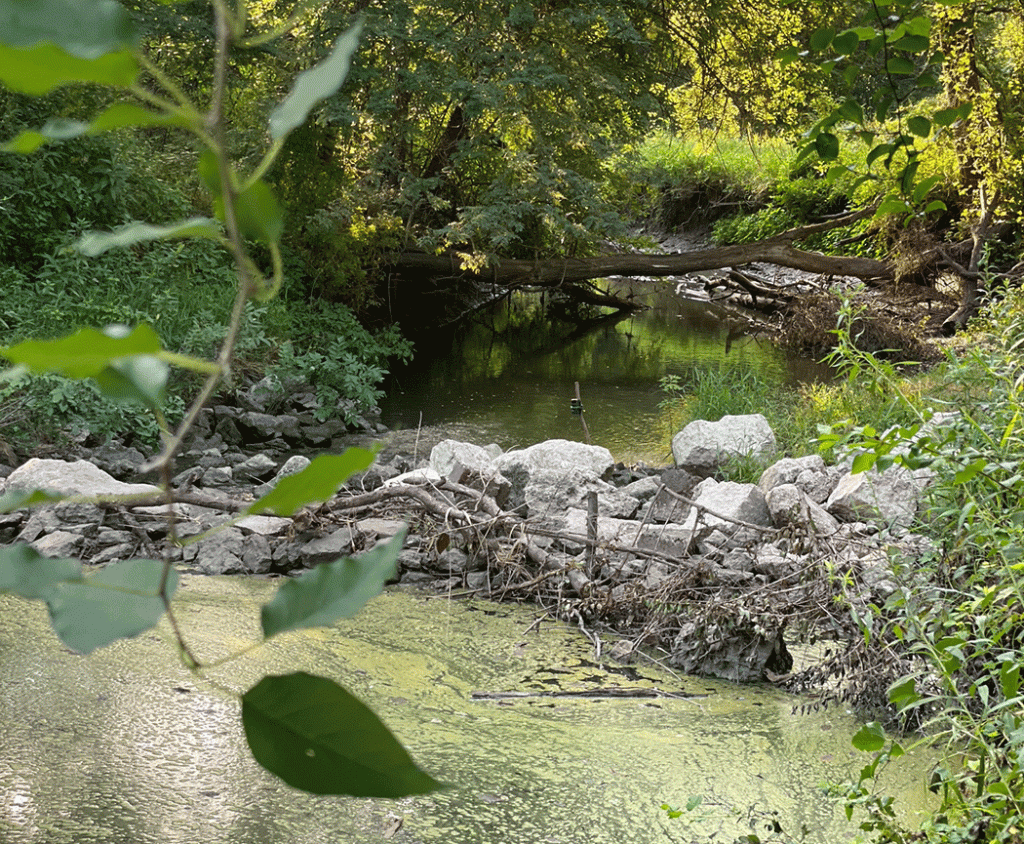
Beaver are among Oullette’s many animal acquaintances at Harmony Forest. A pair of water snakes make their home in the BDA itself, and today there is a snakeskin from a recent shed. Oullette points upstream. “This tree that fell above the beaver dam is [also] filtering the water, so you’ll see beavers coming down in here. They go up and harvest plants and different grasses, and they’ll swim back up the creek,” he says. “From last year, the first spring we put this up, we saw immediate results. We saw more beavers coming here and on Beaver Pond. Other native wildlife, this great blue heron, are here. And we’ve got two woodpeckers living here. You connect to nature on a level that’s so personal it changes your life.”
Iowa has more than 1,000 waterways, and more than half are impaired. The Sustainable Community Development Association is working to change that by helping property owners with the necessary analysis and DNR permitting to set up beaver dam analogs as well as wetlands, swales, and rain gardens. The key is to slow the movement of water, allowing plant roots and sediment to filter out runoff.
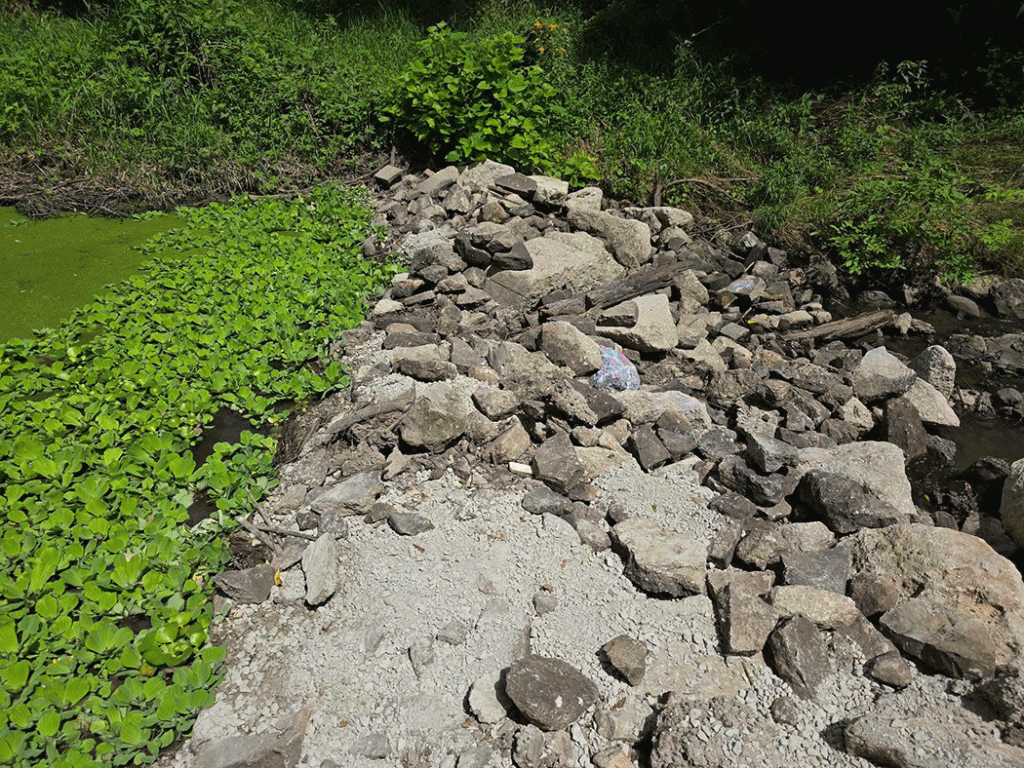
Oulette tells me that the single BDA at Harmony Forest has helped to maintain consistent water flow, even when other sections of the creek have subsided from lack of rain. He attributes this to the land holding more water several yards out from either bank where the BDA slows the creek. “It creates a nice buffer for when there’s not as much water, a kind of a sponge effect that is very, very beneficial to local wildlife and plants and everyone.”
Slowing down water has myriad benefits for humans as well as wildlife. Swales, wetlands, rain gardens, and even no-till agriculture can create the sponge effect Oullette describes. This prevents flooding and improves drought tolerance, according to the EPA.
Slowing the movement of water also replenishes the aquifers many communities rely on. “When you have high-speed water, it creates more erosion. So you want to slow that water down, allowing it to go back into our water table and aquifer, Jordan Aquifer,” Oullette explains.
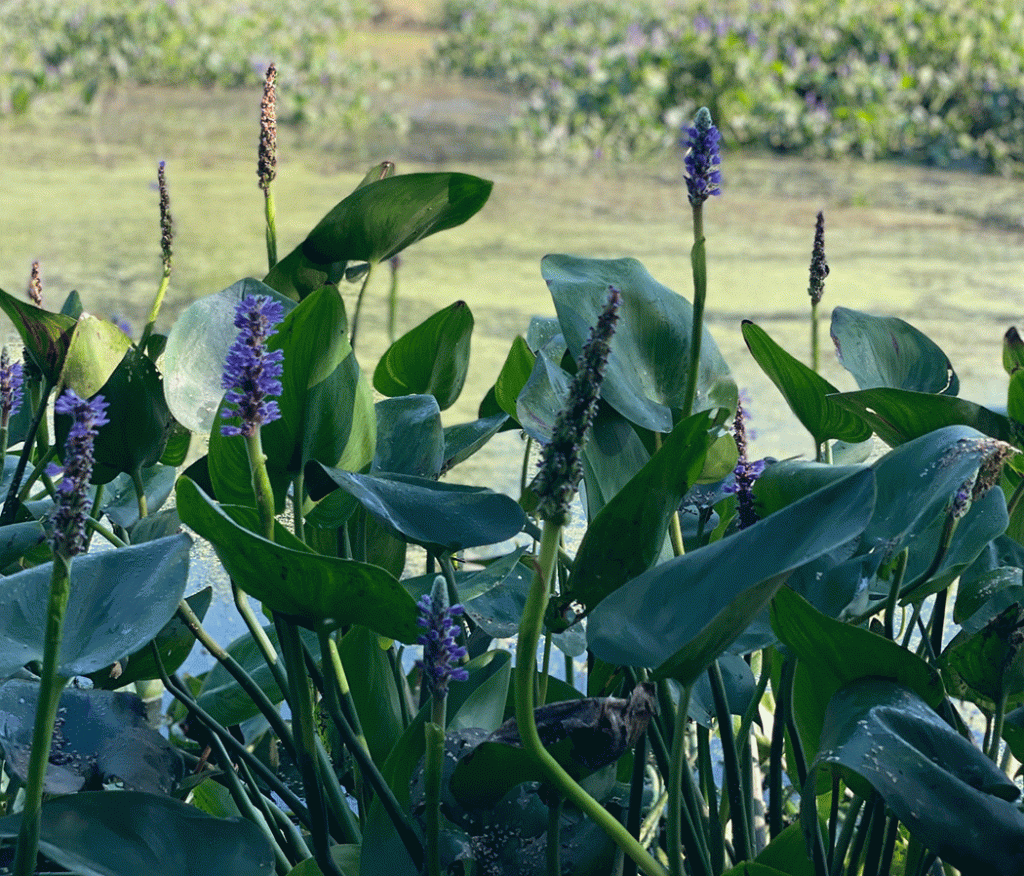
As we explore the meadows and old oak woodland upslope, and wade into the mud for an up-close view of the water lilies, Oullette notes different techniques and opportunities for stewardship. “We want the standing deadwood to allow for grubs and different bugs to live there. Woodpeckers and other other birds will eat the bugs. We need that deadwood to provide an ecosystem for them. Obviously, the woodpeckers live in it as well. It’s their home.”
One of the most ecologically devastating effects of runoff from farms and suburbs is hypoxia. Hypoxia can be likened to suffocation; there is not enough oxygen in the water for aquatic life to survive. Both beaver-built dams and human-built BDAs reverse hypoxia. “These little waterfalls are actually aerating the water, which is creating a higher oxygen level in the creek,” Oullette explains. As water flows and tumbles through crevices in sticks or rocks, falling far enough to aerate without being an obstacle to wildlife, it restores downstream life.
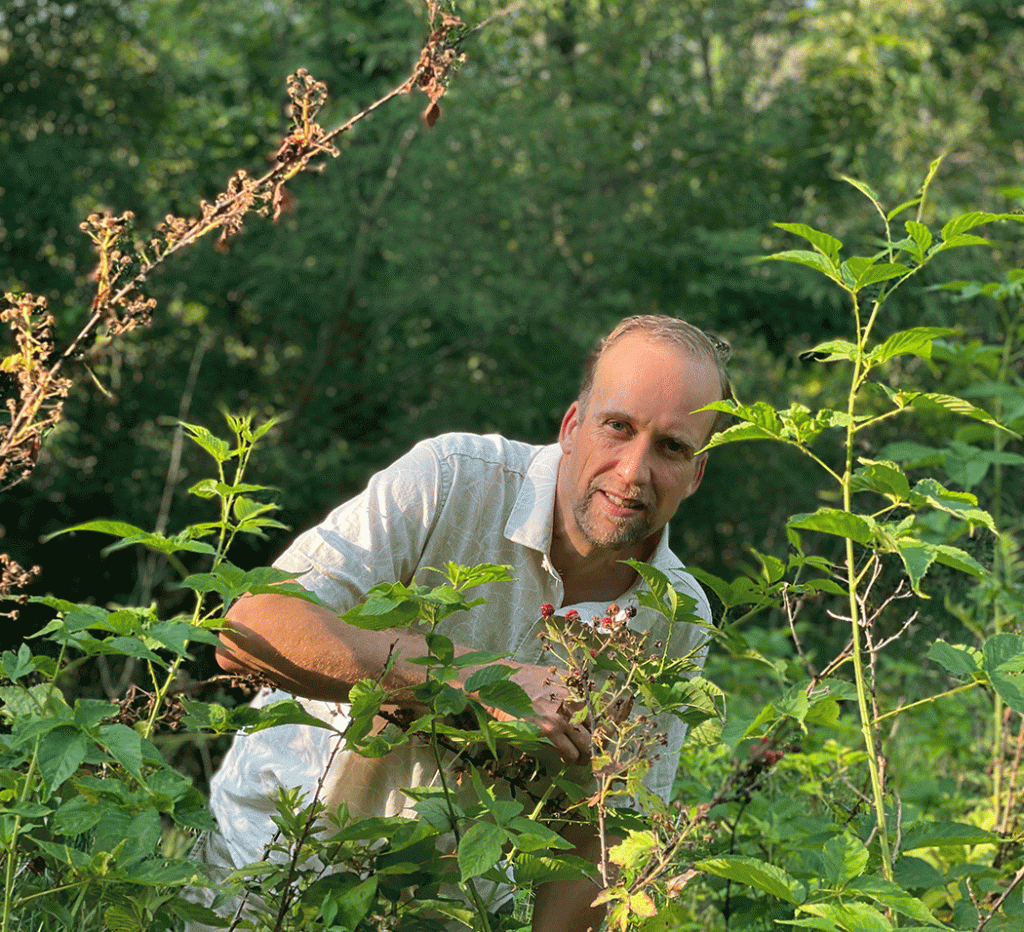
“We are the caretakers of the land, and we’re here to protect it, and also to make it better, to improve it, just like any keystone species does,” Oullette says. “Humans, you and I, can be keystone species if we choose to be. So I’m choosing to be. I know you are as well. That is a conscious choice that humans have. Beavers have it built in their DNA and their instinct. Sometimes I wish we had it built in as well, but it’s a choice.”
Oullette says it’s important to build community and culture around a personal connection to nature and hands-on stewardship. He says he’s excited to wake up in the morning. “Something so simple as a beaver dam analog can attract beavers back to the area and other native species. It’s great to see the diversity that’s here, and it gives a lot of hope for the future of Iowa’s waterways and all waterways around the country and world.”
The public is welcome to visit Harmony Forest and reach out to the Sustainable Development Association for field trips, education, and assistance with ecological restoration projects. Contact Noah Oullette at noah@beaverwetland.org or call (541) 292-2081.