
Consistently unhealthy nitrate levels pollute much of Iowa’s drinking water. Iowa’s pesticide usage per capita leads the nation. The state ranks second in the nation for cancer and is one of three states where the incidence of cancer is growing. What are the connections?
On Thursday, September 3, “Toxic Taps and Cancer: Iowa’s Water Quality Crisis” looks to provide some answers with a panel of experts examining the public health consequences of nitrate and other industrial agriculture pollutants in Iowa’s drinking water and air. The meeting, organized by the Iowa Alliance for Responsible Agriculture (IARA), begins at 6:30 p.m. at the Iowa City Public Library, 123 South Linn Street.
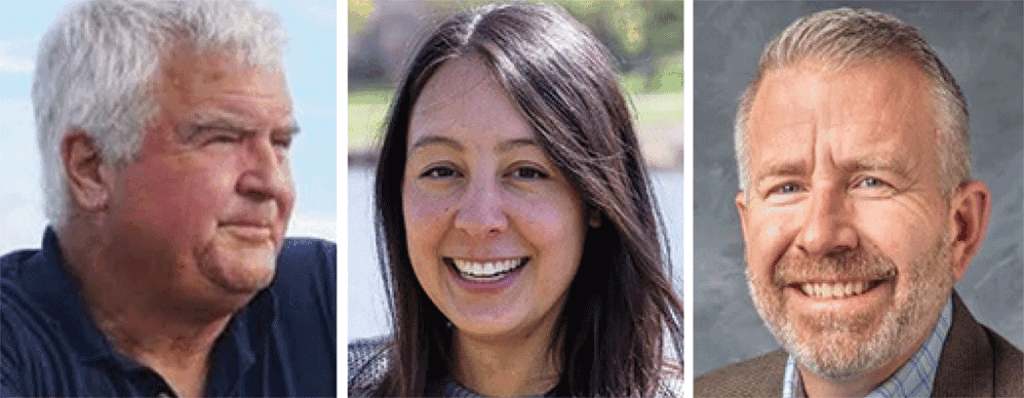
Fifth-generation Linn County farmer Dan Voss is no stranger to cancer. Both he and his wife, Susan, are cancer survivors. Voss will share his experience and how it has shaped their perspectives on the connections between agriculture, environmental health, and community resilience.
University of Northern Iowa (UNI) public health expert Audrey Tran Lam will dive into the health impacts of nitrates, agricultural pesticides, PFAS, and factory-farm-generated particulates. She’ll provide a look at these substances’ relationship with water and air quality and how that affects human health.
Since nitrates and other agricultural toxins wind up in our water, it’s crucial to know what we’re drinking. University of Iowa researcher Dr. David Cwiertny will discuss the value of the Iowa Institute of Hydraulic Research (IIHR) real-time nitrate monitoring network, the status of current funding, and why it’s essential that the state restores full funding to the program. He’ll also talk about a new privately funded program, Iowa INSIGHT, that will expand the scope of water and air monitoring beyond the current IIHR nitrate monitoring network.
Bring your questions for the Q&A that follows the presentations. This meeting will also be livestreamed on the Iowa City Public Library’s website.
About The Speakers
Fifth-generation farmer Dan Voss is a nationally recognized conservation leader from near Atkins, Iowa. Farming since 1975, he was an early adopter of no-till in 1988 and has led the use of practices like cover crops, strip-till, bioreactors, and saturated buffers to improve soil health and water quality.
As Environmental Health Program Director, Audrey Tran Lam has led UNI’s Center for Energy & Environmental Education, working at the junction of human health and environmental sustainability. She holds a master’s degree in Public Health from the University of Iowa and a graduate certificate from Johns Hopkins Bloomberg School of Public Health in Food Systems, the Environment and Public Health. Tran Lam serves on the boards of a host of organizations focused on environmental health.
Dr. David Cwiertny is the Rose and Joseph Summers Chair in Water Resources Engineering in the Department of Civil and Environmental Engineering (CEE) and a Professor in the Department of Chemistry at the University of Iowa (UI).
His research broadly focuses on water quality and water treatment, with particular interests at the intersection of public health and policy. At UI, he directs the state-funded Center for Health Effects of Environmental Contamination (CHEEC), which conducts research to identify, measure, and prevent adverse health outcomes from exposure to environmental contaminants.
The meeting is free. A $5 freewill donation supports IARA’s work advocating for a factory farm moratorium, stronger CAFO regulations, and a fully funded IIHR monitoring network.
Learn more about IARA at IowaResponsibleAgriculture.org.