
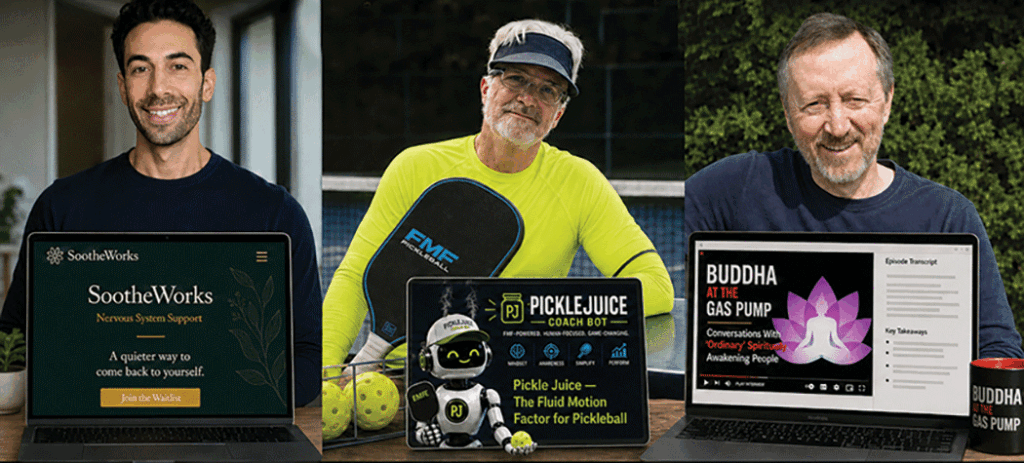
I am humbled. I sort of thought of myself as a power user of artificial intelligence, but then three different guys this past summer excitedly told me how they were using AI to create apps.
Their excitement was contagious, and I resolved to tell you about it.
Tay Winter. Growing up, Taben “Tay” Winter was a voracious reader with a special interest in mind and body, including nutrients, pharmaceuticals, and supplements—and eventually fentanyl.
He gradually realized he was on the wrong track but knew recovery would entail excruciating pain. He thought there must be a better way. And indeed he found a clinic in Colorado that took a measured, non-judgmental approach and used health technologies like auricular nerve stimulation, infrared sauna, genetic testing for methylation status, and vitamin drips during the worst of the detoxification.
Once he was on a new track, at age 31 he enrolled at a community college in Colorado and studied integrative health. And he began to develop a passion to help others facing the challenges he faced.
AI has given him the tools he needed to accomplish this. With the help of Claude Code, he has founded SootheWorks (SootheWorks.co), an app for people who’ve lived through trauma, whether from drugs, violence, or emotional abuse. They learn how to reconnect with their nervous systems and with each other. In addition, a marketplace offers classes and one-on-one sessions.
“It’s unlike anything else on the market,” he says. “The idea is that you meet people where they are, not where you wish they were. The community includes people navigating hard chapters of their lives.”
Thank you, Tay, and thank you, Claude Code.
Paul Stokstad. As a standup comedian, certified tennis pro, college instructor, website designer, improv performer, ballroom dancer, and marketing whiz, Paul Stokstad has endless enthusiasm but limited time for all his passions. AI is helping to change that.
In a matter of weeks, he wrote nine books with the help of AI. As you can imagine, the topics vary wildly: political commentary, AI, local history, mountain biking, satire, philosophy.
His latest passion? Pickleball. Partnering with Steven Yellin, who teaches professional golfers the best mindset for success, Paul has developed a website, The Fluid Motion Factor for Pickleball (FMFPickleball.com), and has created an AI-powered app that interacts with its users. They can tell the app the problems they’re having with their game or what they’d like to improve, and it gives them specific advice. Like today’s AI chatbots, the app gradually comes to know the person and tailors its responses to their needs.
“AI is empowering because in the past creative types who wanted to do a project had to pay other people to create or complete it, either artistically or digitally with computer programming,” Paul says. “Major projects could only happen with major corporate sponsors and investment. Now creative people can use ChatGPT to empower them to do things that previously they would have had to pay for.”
Rick Archer. As I was leisurely walking through Jefferson County Park, Rick Archer came striding from the other direction. He stopped, full of excitement, eager to tell me how he’s using AI.
He’s famous for his Buddha at the Gas Pump video interviews. Yep, that’s the name. When he started in 2009, he wanted to create a platform for ordinary people to share extraordinary experiences they were having of connectedness and spiritual insight.
It struck a chord. His website (BatGap.com) gets about 100,000 visits per month. His YouTube channel gets about 150,000 views per month and has had about 23 million views overall.
So where does AI come in? Rick has done well over 750 interviews, and he now uses AI to create a transcript for each one. He’s had AI write a script that, when executed, performs a whole range of tweaks such as spelling and grammar correction and deletion of filler words such as “you know.” It also creates an introductory list of questions addressed in the interview as well as subheads and callout quotes.
Plus, the AI then produces a file with HTML that can simply be copied and pasted to his website.
He also uses AI to suggest transcript titles, YouTube titles and descriptions, search tags, “key takeaways,” and more.
This material helps people find his interviews—and feeds AI’s “large language models” such that his content is incorporated into AI’s knowledge base.
Three men, three different passions, but a common thread: AI is empowering people to realize their creative desires, whether it be helping trauma survivors connect, fostering pickleball success, or sharing the experience of higher consciousness.
Now I just need to find my passion.